• Skip to primary navigation
  • Skip to main content
  • Skip to footer
Printing for Less

Printing for Less

At Printing for Less, we've offered high quality online printing services since 1996. Shop business cards, booklets, stickers, and more!

My LoginMy Login
800-930-2423
  • Printing
    • Postcards
    • Business Cards
    • Catalogs
    • Brochures
    • Folders
    • Letters
    • Newsletters
    • Envelopes
    • Greeting Cards
    • Print Templates
    • All Products
  • Direct Mail
    • Why Direct Mail Marketing?
    • Every Door Direct Mail® Postcards
    • Direct Mail Letters
    • Catalogs & Booklets
    • Marketing Gifts & Kits
    • Direct Mail Automation
  • Services
    • Mailing Services
    • Pro Services
    • Design Services
    • Custom Printing Services
    • Reseller Program
  • Industries
    • Advertising & Design
    • Food & Beverage
    • Healthcare Payers
    • Healthcare Providers
    • Nonprofit
    • Real Estate
    • Retail
    • Technology
    • University
  • Resources
    • Direct Mail Marketing
      Resource Center
    • Printing Resource Center
    • Blogs
    • Templates
    • Video Library
    • Have a Question?
  • Request Samples
  • Get a Quote

Blog

Get Your Printing Done in Time

BLOG_dont_hold_HEADER_09142016

It’s the holiday season – and that means notecards, coupon mailers, and holiday thank-yous are going to be flooding mailboxes. If you’re planning on mailing printed pieces, you might already be under the gun with a looming deadline. To get your printing done in time, you have to plan for proofing, production, and mailing. We’re going to break it down for you so you can work with your printer (like us, because obviously we’re the best) to meet your deadline.

Print Production Schedules

Before you can start mailing something, you need to get it printed. Depending on what you’re printing this could take time. Typically you’re looking at 4-6 business days to turn around most print projects.

Of course, some projects get done much quicker and others take a lot longer. If you’re adding a lot of custom effects, especially effects that require a plate to be made (a plate is a custom rubber or metal plate used in printing), your set-up time could add another day into the estimate.

You can make the process go faster if you keep these points in mind:

  • Provide final artwork in the right format. This means using the correct color space (usually CMYK or Pantone), the right resolution (usually 300 dpi or higher) and the correct size. This will save you back-and-forth with your printer and will make sure your proof is that much better.
  • Always insist on a proof. A good printer will send you a proof as part of the print job, but if they don’t or if you’re even a little unsure, insist on a proof every time.
  • Check typos and errors before you send the final pieces to the printer. Really go over it with a close eye – retooling a print job can cost you days.

Mailing Schedules

A mailing timeline could take 4-5 business days, after production. Of course this can change dramatically depending on how you’re sending the materials through the mail. The following assumes the artwork for the printed piece is fully approved and the printing presses are about to kick on to print the final piece.

  • Bulk rate is the slowest but cheapest way to mail your printed materials. This option is great for huge orders – over 500 pieces – but takes about 4 weeks from the day your order is placed until the first pieces start to arrive in the mail.
  • Presorted first class mail is the next fastest choice, shaving about 3-4 business days off of a bulk rate’s total time. This type of mailing has requirements on the size, shape, and weight of the mailed piece. It is designed for postcards, envelopes and notecards – perfect for most holiday sends but not boxes or heavy objects.
  • First class mail is the fastest way to ship your print, as you may have suspected it is also the most expensive. It can reach customer’s hands within 6 business days after your order starts production. On average it is about 5 cents more expensive per mailer than presorted first class. The same size and weight limits apply.

Here’s a calendar for a typical production schedule.

Cost to Mail

It can get pricey to send a lot of marketing through the US Postal Service. To reduce cost you may want to consider using the Every Door Direct Mail (EDDM) service. EDDM is a service that allows you to send direct mail to every household in a specific geographic region. You can target a zipcode or specific routes and the post office sends your mailer to every house on the list.

You don’t need a list of addresses – the mail just goes to the homes in the area. This service usually has pretty cheap rates, though it can add some time to your overall delivery dates. Learn more about EDDM here.

There are tight deadlines for getting your printed materials into your customer’s’ hands and with the holidays approaching you shouldn’t wait. If you want to get something in their hands in time for Black Friday, for example, you should be hitting production no later than the middle of October.

Need help with your print? Talk to a live print expert today: 800-930-7978.
Use a Postcard Mailer to Get More Voters

Political_Postcard_HEADER_08182016 It’s the homestretch to the voting booth and if you’re on a political campaign or running for office, then you’ve got to start leveraging every channel to get your message out there. Obama won both elections in large part due to his online savvy, and you should certainly focus efforts on building a robust, smart, targeted digital campaign, but even today there’s room for getting attention with a political flyer. People are already keyed into the election cycle, and you can’t get away from talks about the presidential campaigns. Leverage that top of mind influence to get your own message out there.

Political postcards are a great addition to your campaign. They are affordable, can leverage the US Postal Office’s special Every Door Direct Mail (EDDM) service to reach people in a local area and they can easily connect the dots between physical and digital marketing.

Tips for Making the Best Political Postcard Campaign

We’ve been printing political mailers for local and national politicians for over twenty years. We’ve seen some really great political postcards and we’ve seen some that should have never been inflicted on mankind. Here are some of our tips on how to make a great political mailer.

Use a Graphic that Stands Out

If you can afford a graphic designer with your campaign funds, don’t hesitate to hire one. They are worth the money, helping you design a catchy image, logo, or general design that will get your message out there.

On a political mailer, use a striking, memorable image. That doesn’t mean gaudy or cheap. Political designs are moving toward more modern looks – all the major candidates in the last decade have been using simple, flat designs. Your political mailer should heavily feature your branding and logo.

When to Use a Photograph of the Candidate

It isn’t always a great idea to use the candidate’s actual photograph. If you aren’t getting on television, or already featuring your actual image in billboards and commercials then you don’t gain a lot by putting your face on a political mailer – you aren’t reinforcing any ideas. Spend that space on your message.

On the other hand, if you’ve a look that is unique and resonates with your voters – why not play it up? Managing your personal image is something best left to campaign managers but know that it’s OK to not include your face – voters care about message more.

Make Your Message Stand Out

Reduce your message to the primary components that make you the best choice. Depending on your area, that may mean you launch an attack on your opponent or you stick to your own ideas. Whatever you choose to do, make sure your message is short, actionable, and easy to read on the postcard. Tell them why you want their vote. Make the messaging about them, not you.

Avoid putting text over complex images. Don’t use colors that hide the copy – make it bold and easy to read. Make it short – postcards can almost guarantee they’ll be read but the message has to be concise

Voting Information

Great political mailers always include info about when voting starts. This is valuable information for the voter, and if you can be useful in a postcard you’re likely to keep their attention.

Plan for the Label and Stamp

Don’t forget to plan for the label and stamp! Your message won’t work if it’s under an address label. Use a great blank postcard template for Word to design your card properly.

Give Them A Call to Action

Usually the call to action is to get out and vote – but that may be months away! Give your reader a chance to participate in your campaign today. Give them a call to action that drives them to your website, to your phone lines, or somewhere else where they can take real action to help you. Postcards are great because they can deliver a call to action boldly and without any interference. Use it! Why not drive them to your website to add them to your digital marketing and outreach efforts?

Don’t Forget Your Disclaimer

Political postcards need disclaimers. Check with your local ordinances, campaign legal counsel or others to figure out exactly what you need to say, but don’t forget to account for disclaimers in your design.

Use a Political Mailing Service

If you want to save the time, hassle and headache of sending these postcards out on your own, consider using a political mailing service to manage the mailing to hundreds or thousands of constituents.

Need help with your print? Talk to a live print expert today: 800-930-7978.
Use Postcards to Make an Impact with Holiday Marketing

Holidays_Are_coming_HEADER_08182016v2

We know…who wants to think about the holidays in the middle of the summer? While it’s not tops on our list of fun things either, we recognize that in between pool sessions and BBQs we should probably be thinking about holiday promotions. They’ll be here before you know it, and if you take the time to plan for them, you’ll be able to sit back and watch the business roll in this fall and winter.

If you’re like many businesses, you may rely heavily on email marketing. You may even have a marketing automation solution that is automatically sending your holiday promotional content! If so, good for you, and by all means continue to try and engage your fans through email.

But there’s a dark side to holiday email marketing. A dark, black hole. According to the 2016 Email Marketing Metrics Benchmark Study by IBM, there’s an 18.8% lower open rate for emails sent between Nov 27-Dec 31 (p21). There’s also a significantly higher rate of email send during that time, with companies “often doubling the number of [email] sends” during that holiday window (p21).

How Do I Get My Business Noticed?

So more email, lower open rates…what’s a business to do? The best answer is to use all the channels available. Continue your email outreach, but make sure you’re not lost in the digital onslaught. How? Use a well designed postcard and Every Door Direct Mail® (EDDM®) delivery from the US Postal Service to get your message literally into the hands of your buyers.

The numbers show that, despite common wisdom, people love opening direct mail. It can survive a trip through the holiday black hole. In the 2015 DMA Statistical Fact Book, the Direct Marketing Association lays out some compelling stats about the efficacy of direct mail. Did you know:

  • Direct mail has a 3.7% response rate, compared to 0.62% of all digital channels combined
  • 42% of direct mail recipients either read or scan the mail piece
  • Only 44% of advertisers are using three or more channels, which means more opportunity to get noticed using mail

Best of all, EDDM® is easy to set up, easy to use, and gives you great bang for the buck. Let’s dig a little deeper and see just how easy it is to get started.

Using EDDM® Postcards – Your Secret to Success

When you use EDDM®, you should keep a few things in mind. First, the very name is a reminder of what you’re doing; you’re sending a promotional mailer to every door that exists on a specific postal route. Because EDDM is geographically targeted, it’s a great tool for engaging your customers and prospects that are close to your location.

Next, think about what to send. Using EDDM ® will have some impact on your mailing options, since there are specific size requirements for these mailings. See Templates for EDDM® mailers here.

One tried and true piece of collateral is the postcard. Whether you choose standard sizes or opt for a large version, a vibrant postcard with a strong call-to-action will make an impression and get results.

If you haven’t designed a postcard before, take the time to learn some of the recommendations and best practices for building a strong piece. Our EDDM® Success Kit is a great place to see examples, learn best practices, and understand how to track the impact your campaign has on business.

When thinking about the postcard for your campaign, consider custom options to help your message stand out even further. Own a pizza parlor? Send a postcard die-cut to look like your best-selling pie. Include scented ink to get their mouths watering. What’s that? Yes, there is scented ink and it really smells like pizza. Want something more hands-on? Use a scratch off covering to hide a coupon code.

Best of all, EDDM ® mailings are cost effective. Whether you are sending 5,000 or 15,000 pieces, you can usually get into the hands of your audience for less than 40¢ per piece.

How Do I Get Started with Postcard Marketing?

There’s really no bad time to start your campaign, but as you think about the holidays you should be thinking sooner than later. Consumers are gearing up for big holiday spending and you need to be top of mind as they’re heading out the door.

Give yourself at least two weeks of lead time from when you place your order to when you want your piece in the hands of your audience. That’s enough time to have your postcard printed, get your mailing list vetted and let the postcards flow through the mail.

You can compress that timeline, but since you’re getting in front of it early, there’s really no need. Good job!

Ready to get started? Contact us today to talk about postcards and EDDM. Call (800) 930-7978 or email us to get your EDDM ® postcard campaign going. Your business, and your customers, will thank you. 

The Numbers Behind Direct Mail

Numbers_08032016_HEAD

Direct Mail Offers an Affordable Marketing Option

Direct mail may be the marketing solution your small business is looking for. The direct mail industry is heating up, with overall spending increasing to $9.3 billion 2015. While spending is up, fewer companies are actually using this channel, meaning there is room for your message.

Why Does Direct Mail Work?

Because fewer businesses are using direct mail, there is more room to get noticed. The electronic and social media marketplaces are getting more and more crowded, making it harder to achieve success reaching your customers or to get noticed at all in the digital world. Direct mail has a 3.7% response rate compared to the 0.62% all digital channels together manage to pull in.

The magic of direct mail is that it allows you to place your message directly in your customers’ hands. It arrives in their mailbox and they have to physically touch it and make a decision about what to do with it. You can be guaranteed that they will at least look at it.

Another reason direct mail is a good investment is because it is easy to track and directly correlate success rates. You can see what is working and what isn’t and adjust your strategy. And because you can control when the mail arrives, it allows you to coordinate other marketing into the same time frame, getting a bigger bang for your buck (44% of advertisers are now using three or more channels simultaneously, usually direct mail coupled with email and social media).

Direct mail allows personalization, so customers can receive a letter addressed to their name with an opening salutation with their name as well. This is called variable data printing (VDP) and it doesn’t stop at copy changes. Whole images can be swapped out, color schemes changed, almost anything you think of can happen on a 1:1 basis. Personalization results in a 47% improved customer experience, so this is an important tactic to keep in mind.

Who Reads and Responds to Direct Mail?

Of people who receive direct mail, 42.2% of recipients either read or scan it, while only 22.8% say they don’t read it. That’s nearly twice as many people scanning direct mail than tossing it. Consumers have the most positive response if they are already familiar with the sender, so combining direct mail with other marketing strategies can make a real impact.

55% of adults that buy something through the mail are women, so if you use direct mail, you can hone your message for this group. Response by age of direct mail purchasers is fairly evenly spread among the age groups, but the highest concentration is in the 25-54 age group. Note that the 18-21 age group is rapidly increasing and has tripled in recent years. Some speculate that this age group doesn’t receive much mail at all (they do everything online) so any mail they get stands out to them. This may be a group to focus on if you’re looking for the hottest demographic to tap.

Will Direct Mail Work for You?

Studies about direct marketing show it is most effective for department stores and credit card companies, however these are businesses that spend the most on direct mail and have an enormous volume of business. What about small and medium sized businesses?

Industry statistics show response rates for restaurants have been on the rise with consumers responding to 18.6% of the direct mail they get from restaurants. Direct mail has double digit response rates for other kinds of small businesses including specialty stores, auto maintenance, leisure services, and more. Direct mail coupons have a 2.7% response rate for nonfood and an overall 6.5% response rate for food which is higher than the rates for newspaper inserts and magazines.

Direct mail response rates are second only to telephone sales, which comes in at 9 to 10%. Direct mail comes in second though, above all other types of marketing and can be the perfect choice for a small business.  If you develop a house list, you’ll find you can target your mailings more directly to consumers who are more likely to be interested. Response rates to house lists have been rising so this is definitely an area to direct your attention.

Choosing Direct Mail

If you are interested in direct mail, carefully select a target audience for your direct mail project. You can buy or build a list but no matter where it comes from, it should hone in on the group that will be most interested in your product, service, or offer. The 40/40/20 rule of direct mail marketing says that 40% of your success depends on identifying your list, 40% depends on your offer, and 20% depends on the design of the mailer. It’s also important to keep in mind the kind of response you want to elicit and how you can track it.

For example, it you’re providing a coupon, you can directly track the sales from the mailer. However, no matter what kind of offer or ad you send, don’t forget to take into account the amount of repeat business you may develop from those who don’t respond but later patronize your business because you’ve raised their awareness or made an impression.

Successful Direct Mail

Some people are reluctant to use direct mail because they think it’s just going to get lost in the stack of mail consumers are getting. In fact, mail volume has been steadily decreasing (down by 35% over the past decade as more and more bills are handled online and fewer catalogs are being used), so direct mail is actually a great platform for standing out.

The competition in standard class direct mail is more intense (56.7% of the mail people get is standard mail), but if you choose to send your mail first class, there is less mail in this category. Direct mail tends to be most successful when it looks less promotional and resembles regular mail, sent in an official looking envelope, so the design and delivery of your piece is crucial. More customers respond to direct mail when a courtesy-reply envelope (not a business-reply) envelope is enclosed.

You are also more likely to find a higher response rate if you consider other mail formats. An oversized envelope has a 5% response rate but you can also do well with postcards (4.25% response rate), dimensional mailings (4%) or catalogs (3.9%, which is interesting since consumers always report positive reactions to catalogs but their response rates don’t match their interest).

Isn’t Direct Mail Expensive?

Direct mail is actually priced very competitively, coming in at $19 per acquisition. Compare this to $16-18 for mobile and social media, $21-30 for paid search, $41-50 for internet display ads and $11-15 for email.  Direct mail offers a great return on your investment, 15-17%, which is the same as social media.

Direct mail offers an affordable, effective way to engage consumers who would be interested in your small business. By placing your carefully crafted message directly in their hands, you can expect to see a great return on your investment.

Ready to start your own direct mail campaign? Whether you need help designing the piece, printing it, or sending it to your mailing list, we’re ready to make your mailing a success. Contact us today to get started: (800) 930-7978.


Note: All stats cited here (that aren’t already linked) come from the DMA 2015 Statistical Fact Book, the leading source for direct mail research.

How Small Businesses Can Use Direct Mail

Dreamforce_Blog_600 Direct mail is one of the tried and true channels of marketing. It has been in use for a very long time and forms one of the foundations of the traditional marketing mix. With the rise of digital marketing, direct mail has fallen from popularity, replaced by email, search engine marketing (SEM) and targeted ads. Email has become the go-to mode of marketing for nearly all businesses and the result is a flooded inbox. Maybe digital fatigue is why people are up to 5% more likely to respond to direct mail than other forms of marketing, including email marketing.

Can you combine your offline and digital efforts? Today you certainly can. Technologies exist that can help businesses of any size merge their offline and online marketing. Both are better when they work together to deliver messages across different channels (cross-channel marketing).

Small businesses can benefit from adding direct mail to their marketing mix and take advantage of techniques that combine direct mail with digital marketing.

Make a Message that Sticks

The singular power of direct mail isn’t that it is accessible but that it is intimate. Your message – your brand – is sitting on a customer’s kitchen table. It is being held in their hand. Email simply can’t do this. Direct mail is as close to face-to-face communication as you can get.

This a great opportunity to break the mold and stand out. Your message has to be well designed, with a clear call to action and a powerful hook to get their attention.

Once you’ve got their attention – if even for a moment – don’t squander it. The rest of this article is full of innovative ideas for using direct mail but none of them work if you’re sending boring marketing. Take the time (and resources) to really build an excellent piece of direct mail.

Use Personalized Direct Mail

The power of personalized messaging is critical in all types of marketing. Studies show that personalized messages are 6 times more likely to be opened, read and acted upon. Direct mail can be personalized much like email. This level of personalization goes beyond just using your customer’s name. You can add any sort of info that you’ve got access to. For example, you could send a promotional birthday coupon that lands in their mailbox. You can tailor messaging to match gender, location, age or other data. In the printing industry this is called variable data.

Here are some ways to use personalized direct mail:

  • Birthday coupons
  • Personalized maps from their home to your location
  • Gender based design, copy and layout or discounts
  • Age based discounts
  • Use past purchase history to promote new products or offer special savings
  • Reminders of their customer anniversary with your business
  • Print industry-specific messaging and images
  • Include geographic messages and images that resonate with a customers in a certain place

Variable data printing is available as part of a digital print run. Digital printing allows for quick turn arounds and is cost effective if you are doing smaller batches of materials.

Target a Geographical Area

Every Door Direct Mail® (EDDM) is a unique characteristic of direct mail that digital channels can’t easily match. EDDM is a service offered by the US Postal Service (USPS) that allows you to send direct mail to every house in a geographical area. For example, you could send a mailer advertising your grand opening to every home in a specific ZIP code. This is a great way to hit specific communities, neighborhoods and residents.

The service offers cheap postage rates and the USPS provides the address information so you don’t need a customer list! You just pick the area you want to target and your direct mail gets sent to every home in the area.

Using EDDM to promote a restaurant (especially one with a delivery radius) is one great way to use EDDM but you could combine it with a bit of personalization. Because EDDM is getting blanketed across an area, traditional personalization doesn’t make sense but you could call out the characteristic of a neighborhood – maybe reference an iconic building, piece of art, or local sports team. People are proud of where they live, why not make that part of your marketing strategy? Use that pride to get them to read your message.

Here are some great ways to use EDDM:

  • Target households in your delivery area
  • Combine EDDM campaign with an established community event, like a summer concert or major sports event
  • Message to neighborhood pride, building empathy with the community
  • Use neighborhood rivalries
  • EDDM is especially useful for restaurants, grocery stores, local service companies and other businesses that have a neighborhood-scale reach

If you want to know more about EDDM, we’ve got a comprehensive article on it right here.

Direct Mail Creates Urgency and Builds Buzz

Time sensitive sales are a great way to get customers into your business. If you’re trying to create a sense of urgency, direct mail is a good idea. It is less likely to get ignored and a bold, memorable design will combine well with an urgent message. Make the time-sensitive component stand out and don’t be afraid to use loss-language (Hurry! Offer ends soon! This is your last chance!). Even if it seems overdone, loss language works.

Turning the direct mail piece into part of a promotion is even better. You can build buzz by having the mailer serve as a coupon, ticket, or game piece. This helps keep your message in hand and top of mind, and even if the customer can’t make it to your grand opening or big sale, they will remember you. There are advanced printing options that can make this sort of mailer stand out, such as metallic inks.  

Combine Offline and Online Marketing

You can combine direct mail and digital marketing pretty easily. Larger companies use marketing automation platforms to make this a fairly seamless process, but you can do it on a smaller scale too. One thing to keep in mind is the way you can direct your customers using these different channels. If all you have are email addresses, direct mail isn’t much use. For small and medium sized businesses it can make more sense to use direct mail to drive traffic to your site, not the other way around.

You could send a mailer that points the customer to your website, drives an existing customer to leave a review, or a household on an EDDM route to check out a promotional page. This tactic works best if the page you drive them to is a valuable resource. The page shouldn’t just be sales copy, create something fun, useful, or meaningful that keeps them sticking around.

Once they are on your website you can try to capture more info such as an email address and personal info like age, gender, and even birthdays. Be mindful with how much info you request, it can be perceived as annoying and it doesn’t add any value to your customer.

Keep URLs used in direct mail short and simple. Consider using personalized URLs (PURLs) as variable data. Creating unique PURLs for your customers may be too costly for a small business but you can create a specific landing page for a direct mail campaign. The goal is to make sure your PURL or campaign landing page has a short, simple, easy to remember address.

If you do have both a customer’s email and their physical address, you can really start to combine things in fun, unique ways. Direct mail pieces can reference emails you’ve sent, and both can drive the customer to new product pages or get them to take an online action like leaving a review or sharing your businesses on social media.

Direct mail isn’t dead and can be a huge boon to small businesses, especially when it is combined with digital marketing. If you want advice on how to best use direct mail for your specific business, our customer advocates are here to help. Printing for Less has been helping small and medium businesses hit their marketing goals for over twenty years. You can inquire here or give us a call at 800-930-7978.

RGB vs CMYK vs Pantone (PMS): What’s the Difference for Printing?

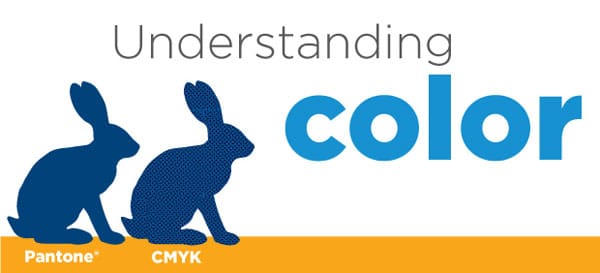
PMS vs CMYK color

CMYK, Pantone, and RGB are three different color systems in graphic design and printing. Knowing what each of them means may be the difference between a perfect final draft and a project that looks completely different than what you expected.

But First, a Little Art and Physics

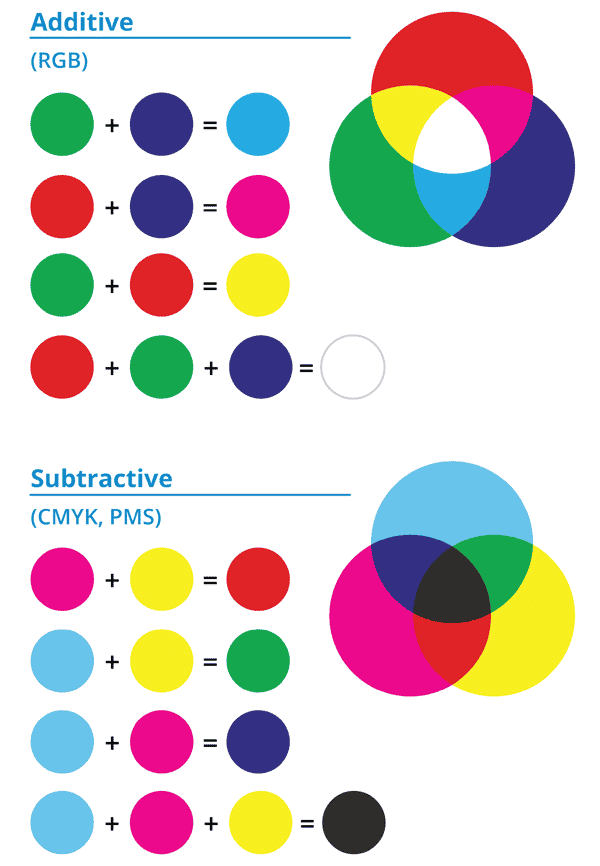
You’ve probably mixed paint together before, like red and green to get a murky brown. This is called subtractive color mixing.

However, if you shine red and green spotlights together on a wall, they mix to make yellow. This is additive color mixing. In additive color mixing, you get white when you mix red, green, and blue. It’s counterintuitive, and a little spooky the first time you see it — but it’s true!

additive and subtractive colors

This is the same thing that happens on your computer screen. Little pinpoints of red, green, and blue light (RGB) blend together and create the array of colors you’re looking at right now.

The problem is, if you’re a graphic designer working on your laptop, how can you ensure that the colors you’re seeing are going to translate to online and offline media?

Before we get into the details of converting Pantone to RGB or CMYK to PMS, let’s define these color systems.

CMYK Color

If you remember learning about primary colors in grade school, you have a good start for understanding how CMYK works. CMYK stands for cyan, magenta, yellow, and black (the “k” comes from the word “key,” a printing term). You can mix these four colors to get an array of secondary and tertiary colors like violet, orange, and just about every color from your kindergarten crayon box.

However, the one pitfall of CMYK is that different brands of ink tend to have color palettes that vary from each other. If you’re using different printers for your branded materials, your colors may not be 100% consistent.

Pantone (PMS) Color

Unlike CMYK, Pantone uses a standardized color reproduction system referred to as the PMS color process (Pantone Matching System). Each Pantone color, or “spot color”, has a unique identification number.

This system allows you to take your Pantone color to any printer on the planet and have your project come out with exactly-matching hues. And if you’re a brand that relies heavily on a very specific color (think “Home Depot Orange,” “Coca-Cola Red”, or “Barbie Pink”), you can see why Pantone would be invaluable.

The only down side to the PMS system is that your options are slightly more limited than CMYK. Because Pantone has a predetermined set of colors, you’ll have to work within their system. In other words, you can’t create any color and translate it flawlessly to Pantone.

Instead, your color-picking process is more like when you visit the paint section at the hardware store. You select from a range of shades available to you, and an employee mixes that exact shade for you to take home.

RGB Color

As we mentioned up top, RGB uses three colors (red, green, and blue) in different combinations to create every color of the rainbow. On computers, TVs, and mobile devices there are small dots of light in your screen that emit different amounts of red, green, and blue. Your eyes interpret these mixtures as different individual colors. RGB uses a subtractive color mixing process to create all colors, where RGB together makes white and the absence of red, green, and blue makes black.

Which Color System Should I Use?

Is CMYK “better” than Pantone, or RGB? No one system is inherently better, but one may be better for the project you’re working on.

The PMS process allows you to keep your colors consistent no matter where, or what, you print. This is useful if you’re a larger company with vendors across the globe: you can rest easy knowing your logo is going to look the same on a business card or a giant banner at a convention on the other side of the country.

On the other hand, if you’re printing fine art or photographs, you may find Pantone to be limiting. Pantone colors don’t blend easily, so you’ll probably need CMYK to get the variance you need.

And don’t forget to consider the type of printer you’re using. If you’re doing digital printing, Pantone colors don’t translate well on paper, so you’ll want to opt for CMYK.

However, with offset printing, you can take your pick: both CMYK and Pantone produce great results.

Combining CMYK and Pantone in One Design

You don’t always have to stick with one color system in a single design project. In fact, you may be able to achieve exactly the look you need — and save some money — by combining Pantone and CMYK inks.

This is called spot-color printing, or “five color process.” When you print this way, you use a mixture of the standard CMYK colors, but you also add one or two Pantone colors to get specific hues just right.

For example, imagine you’re Coca-Cola and you’re printing the billboard pictured above. Coca-Cola red is a very specific color, and needs to remain consistent across all branded materials — this billboard included.

However, some of the other elements of the design, like the colors of the bottle and soda, don’t need to be as exact. For the most cost-effective process, you would use a Pantone for Coca-Cola red, and CMYK for everything else.

If you were to see the printing press running for this job, you’d see one plate with the red PMS color for the Coke logo, and four other printing plates with CMYK blends to get the color just right.

Converting Between Color Systems

With the prevalence of web design and digital design today, it’s common to have to do color conversions between these three main systems when creating printed materials. Here’s a basic rundown of what to expect when converting between RGB, CMYK, and Pantone, along with links to more detailed tutorials.

RGB Conversions

RGB is used for digital rendering and can have issues when being reproduced with a CMYK or Pantone process. However, sometimes you may be working with a design that originated in RGB and needs to be converted for print. You can usually get your final design close to the original, but know that there are some colors in RGB that simply can’t be reproduced in CMYK or Pantone.

RGB to CMYK

  • RGB to CMYK online converter
  • Converting RGB to CMYK in different programs
  • The differences in appearance between RGB and CMYK

RGB to Pantone (PMS)

  • RGB to Pantone online converter

CMYK Conversions

With most CMYK colors, there is a matching Pantone color out there. The same goes for CMYK to RGB. Most graphic design programs have a built-in process for converting CMYK to Pantone, but you can also use an online tool to make these conversions.

CMYK to RGB

  • CMYK to RGB online converter
  • How CMYK and RGB are different onscreen

CMYK to Pantone (PMS)

  • Online CMYK to Pantone Converter

Pantone (PMS) Conversions

Converting Pantone to either RGB or CMYK isn’t problematic for most colors. However, if you’re working with a metallic, pastel, or fluorescent hue, Pantones don’t always convert well to CMYK.

PMS to RGB

  • Pantone’s official color finder tool
  • Directory of Pantone to RGB (hex) colors

PMS to CMYK

  • Pantone’s official color finder tool
  • Details on the differences between PMS and CMYK

Learn More About RGB and CMYK Color Printing

  • « Go to Previous Page
  • Page 1
  • Interim pages omitted …
  • Page 27
  • Page 28
  • Page 29
  • Page 30
  • Page 31
  • Interim pages omitted …
  • Page 48
  • Go to Next Page »

Footer

Printing for Less

info@printingforless.com
100 P F L Way, Livingston, MT 59047

800-930-2423

  • Home
  • Products
  • Services
  • Industries
  • Get Printing Samples
  • Direct Mail Marketing Resource Center
  • Printing Resource Center
  • Blogs
  • Templates
  • Terms & Conditions
  • Contact
  • About Printing for Less
  • Careers
  • Login

Copyright © 1998-2026 PrintingforLess.com. All Rights Reserved.

logo
  • 800-930-2423
  • Products
  • Direct Mail Marketing
  • Services
  • Industries
  • Direct Mail Marketing Resources
  • Printing & Mailing Resources
  • Get a Quote
  • Contact Us
  • My Login
Direct Mail Delivery
This field is for validation purposes and should be left unchanged.

Get 20% Off*

Your First Print Order

Name(Required)

*By subscribing, you agree to receive weekly emails from Printing for Less. Some exclusions apply. See details.