• Skip to primary navigation
  • Skip to main content
  • Skip to footer
Printing for Less

Printing for Less

At Printing for Less, we've offered high quality online printing services since 1996. Shop business cards, booklets, stickers, and more!

My LoginMy Login
800-930-2423
  • Printing
    • Postcards
    • Business Cards
    • Catalogs
    • Brochures
    • Folders
    • Letters
    • Newsletters
    • Envelopes
    • Greeting Cards
    • Print Templates
    • All Products
  • Direct Mail
    • Why Direct Mail Marketing?
    • Every Door Direct Mail® Postcards
    • Direct Mail Letters
    • Catalogs & Booklets
    • Marketing Gifts & Kits
    • Direct Mail Automation
  • Services
    • Mailing Services
    • Pro Services
    • Design Services
    • Custom Printing Services
    • Reseller Program
  • Industries
    • Advertising & Design
    • Food & Beverage
    • Healthcare Payers
    • Healthcare Providers
    • Nonprofit
    • Real Estate
    • Retail
    • Technology
    • University
  • Resources
    • Direct Mail Marketing
      Resource Center
    • Printing Resource Center
    • Blogs
    • Templates
    • Video Library
    • Have a Question?
  • Request Samples
  • Get a Quote

Blog

Booklet Printing: Going Beyond the Brochure

Perhaps you’re aiming to reach as many new customers as possible before a big promotional event. Or you just launched a new product that is a perfect fit for your existing customer base. Whatever your goals, custom booklet printing is a great way to spread your message, showcase your products and create buzz around your business.

There are times when printed materials like a brochure or a rack card don’t have the space you need. Maybe the look and feel needs to be more substantial to communicate the value you offer. In these scenarios, a custom booklet strikes a great balance between those smaller formats and a larger piece like a poster.

Booklets are much like a mini-catalog and can be printed with a matching envelope or mailer, giving the finished project a polished, cohesive look. Booklets are usually assembled using a saddle stitch method that then allows the booklet to fold flat for mailing. While saddle stitch finishing is common, other options like perfect binding, square back binding or Wire-O binding can help create that particular look you want.
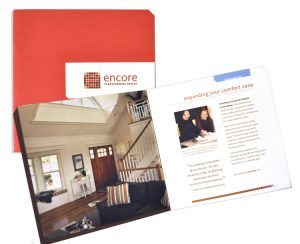
booklet printing

Consider a booklet when you want to highlight large imagery, like an interior designer or architect may need to do. Colorful booklets grab attention and have plenty of space to convey important details about your services or products. Attractive booklets are less likely to be thrown away than a traditional brochure and can help engage your target market.

You may want to include industry specific tips and tricks that your customer will find helpful, increasing the value of the booklet. You could position it as a “How To” guide, or turn it into a handy pocket reference that your audience will use again and again.

Another way to capture customer attention is to incorporate personalization in your booklets. Little details like printing the customer’s name or targeting imagery based on their previous purchase habits with you can make a significant impact. For example, if your database shows that a particular group of customers always buy a specific brand from your showroom, you can customize each booklet for that segment to showcase that specific brand on the cover.

You can upgrade the look and feel of your booklet by graduating the size of each page assembled. This will give you attractive “tabs” that can be incorporated in the design and make it really stand out. This option is easy to implement and increases the appeal significantly. Another option to make your piece stand out from the crowd is to pick  a non-traditional size, which can be easily customized to match your unique needs. We offer booklet size options ranging from small (2.95″ x 4.72″) all the way up to enormous (12″ x 13.9″)!

Need help with your print? Talk to a live print expert today: 800-930-7978.
Rack up the Business with Rack Cards

Sometimes the amount of info you want to communicate falls right in between business card and brochure. The business card isn’t enough canvas, but the brochure is over-kill. Sitting snugly between these two options a handy solution—the rack card.

What the heck is a rack card, you ask? Basically, rack cards are smaller-format printed pieces that measure 4″ x 9″ and can be produced in a variety of sturdy cover stocks and printed on one or two sides. Think of it as just one panel of a brochure. You’ve most likely seem them used to promote tourism and travel-related businesses such as hotels, theme parks, museums and attractions.

However, they can also be used to promote a wide range of other businesses and services such as spas, restaurants, schools, dry cleaners, car washes, special events, pet services and more.

The keys to successful rack card marketing include:

  • Eye-catching design
  • Call to action or offer
  • Placement in all the right locations

Make Your Cards Stand Out

Double Take

Make sure your piece stands out with eye-catching graphics and a bold headline or offer, especially if your card will be placed in a rack with hundreds of other cards.

When you have a preliminary design, look at it in context with other cards. Is yours different, inviting? Take a step back and try to spot your card from three feet away. Use bright colors, engaging fonts, and crisp, relevant images to make your message leap off the rack.

Prominently feature your contact information, including phone, website, and email address. Consider featuring a map to your location, especially if you target visitors who don’t know your area. If you’re a service provider, consider adding a list of services and prices on your card. Restaurants can list their select menu items or feature a coupon.

Remember, you have two sides to work with. Keep the front simple and engaging. Never forget that white space is your friend. Put your detailed information on the back of the card.

Make Them an Offer They Can’t Refuse

An offer they can't refuse

Target your customers with an enticing offer or invitation. This incentive will help drive business for your product or service. Some ideas:

  • 2 for 1 admission
  • Percentage discounts
  • Added freebie with a purchase
  • Kids dine free

You can even add a perforation to the bottom portion of your rack card for a tear off business card or coupon. Pretty snazzy, huh?

Make them ubiquitous

Location

Distribute your rack cards far and wide to reach as many potential customers as possible. Place them in high traffic locations where they are sure to be seen and taken. Ideal locations for travel related businesses are visitor centers, chambers of commerce, convention centers, hotel lobbies, restaurants, and rest stops.

For retail goods and services, ask local businesses (not your competitors) if you can place your rack cards in their store or office. Consider using branded rack card holders or stands to capture attention and reinforce your business. Spread your message far and wide to see the most return on your investment.

Ready to get your rack cards created? Check out these great design ideas, call us at 800-930-7978 or get your quote today.

How to Use Special Printing Effects to Create a Unique Experience

While browsing a bookstore, I am like a crow with a bottle cap: I walk slowly, pecking around, until a shiny book jacket or spine catches my eye. The letters are debossed into the hardcover and filled with gold. I snatch it up, unable to help myself. That’s the one I want.

large colorful bookcase

People are naturally attracted to the item in the room that is the shiniest, the smallest, the greenest, the sharpest, the most bizarre or outlandish — anything different. Difference piques curiosity.

Perhaps it’s a reflection of our own social desires: we want to be seen as unique, too. Dale Carnegie in How to Win Friends and Influence People calls out the “desire to be important” as one of the top human needs.

We all want to think we are the book with the classy jacket.

Uniqueness may not be easy to cultivate, but it is absolutely worth the effort — especially in business. Think about it. Everybody has a platform these days. There are over 1 billion YouTube users, with videos on every topic imaginable. Businesses no longer just sell things. They are subject-matter experts, teachers, and even entertainers.

How can your print materials catch your audience’s eye? How can they establish or maintain your credibility, your place in the market?

To answer that, we’ll have to look closer at that little hardcover book I found at the bookstore.

Memorable Experiences Are Multisensory

The book that caught my eye didn’t just catch my eye — it caught my sense of touch, as well. The most memorable experiences are multisensory.

Here’s an example. Imagine reading a book about the Rocky Mountains. If the text is well-written, you may feel awe-inspired by the bigness of the mountains. You may be able to see, in your mind, the view from a peak as gigantic shadows of clouds drift across a purple range below you. You may be able to imagine the rush of a creek or recall the smell of pine trees from a former experience.

But when you actually hike in the Rockies, all five of your senses are engaged. The experience transforms you. It moves you to action: to plan another vacation, to bring a loved one on your next visit, or maybe even volunteer to build trails.

There’s a similar effect when we handle printed materials. When our vision is the only sense being engaged (like the written content about the Rockies in the first example), we do respond emotionally — but it’s nowhere near as powerful as getting to do the thing firsthand, where all five senses are engaged.

The Power of Special Printing Effects

How can you engage multiple sense with your printed materials?

It all comes down to special printing effects. It’s that extra little bit, like the frosting on the cake, that makes your piece complete and truly memorable.

While the education industry is constantly toying with visual and sensory techniques to aid the learning process, modern businesses are using the same techniques to increase sales. And they’re getting results. TV commercials have done this with color and sound for years, while malls often incorporate scent and taste to influence buyer behavior.

You can do the same thing with your print materials. Here are several ways.

Embossing and Debossing

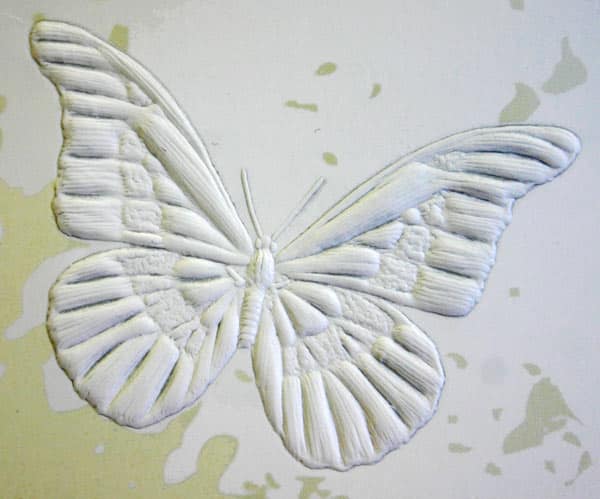
An emboss or deboss changes the texture of paper by raising (or lowering) a relief of a design. You’ve probably encountered embossed content before: it’s almost impossible not to touch it.

“Tactile stimuli go much deeper than visual or auditory stimuli,” says Dr. Martin Grunwald, founder of Leipzig University’s haptic research laboratory. Studies on haptics (the sense of touch) show that we understand material deeper when we go beyond what’s visual. The sense of touch is both learned earlier and retained longer than the other senses.

Embossing Sample

“There is still an enormous development potential in the field of haptic advertising,” says Grunwald. One way to tap into this powerful effect is through embossing or debossing. It creates a 3D experience out of a 2D object, beckoning the viewer to use their fingertips to touch the embossed section as they take in the visual message simultaneously.

When to use an emboss or deboss: These are most popular on business cards, brochures, and luxury print items like invitations to create a lasting impression. However, they’re not restricted to any type of print project, and can be combined with color or left uncolored (a blind emboss) to create real works of art.

Die Cutting

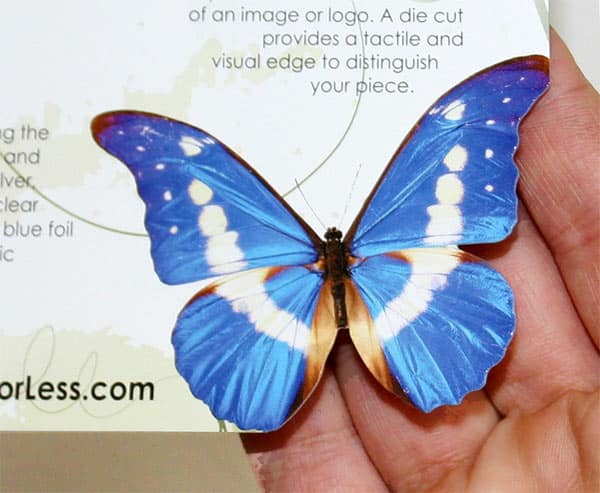
If you’ve ever held a print piece shaped in some other way than a square or rectangle, you’ve probably seen a die cut. Die cutting uses a metal blade (the die) to “stamp” a custom shape out of a printed piece. It can function as a window on the front panel of a brochure, enticing the reader to open it up and see the hidden parts of the message inside.

Die Cutting Sample

Die cutting can also create standalone pieces in unusual shapes (stars, hexagons, or your logo, for example). Pop-up book creation includes die cutting to create the elements that rise off the page.

When to use die cutting: Enhance an image or words by framing them or making them stand out against another background. Die cutting can get expensive, so use it for luxury items or high-value sales opportunities.

Unique Inks

While embossing and die cutting can be left blind and colorless, the addition of other special printing effects, such as glimmering foil stamping, can attract the eye and prompt your customer to touch.

Ink can even increase the amount of time customers spend interacting with your piece, and ultimately, your brand. Glow-in-the-dark ink, for example, can only be revealed in the dark — meaning your customer gets to have a little fun before they get your ultimate message. Every extra second your prospect spends with your design strengthens their connection to your business or brand.

When to use unique inks: Foil stamping is ideal for invitations, luxury businesses, certificates or awards, and classy business cards. It’s natural for customers to assume higher quality or elegance when they see a foil-stamped item. It looks expensive, and so the customer associates quality and class with your brand.

As for other unique inks like Pantone colors, metallic inks, and bioluminescent ink, the sky’s the limit. As long as these effects fit your message and brand identity, they’re sure to create a lasting impression.

Scratch-and-Sniff

It’s not just for the kids anymore. Scratch-and-sniff print designs excite your customers’ olfactory sense, which is nearly impossible to do in any other way. Despite having the ability to detect one trillion unique scents, humans haven’t yet incorporated anywhere near that many description words into our vocabulary for aroma. So don’t describe your bakery’s new item in a postcard: let the customer experience it through their own sense of smell.

When to use scratch-and-sniff: If you’re selling food, beauty, or bath products, scent plays a vital role. But aromatic advertising isn’t limited to specific industries. A holiday promotion at any company might do well to send out mailers that smell like fresh-baked cookies — or a kids’ clothing company could get great results from providing fun scratch-and-sniff promotional stickers.

Real Experiences Are Rare

When you put it all together, one thing is clear: real experiences are rare these days. Though the internet and technology as a whole has improved our productivity and allowed us to connect in a million new ways, our other senses long to interact with the world, too.

We still get a surge of joy when we taste, smell, and touch physical objects around us. And often, these are the feelings that last — and truly inspire us to take action. “Whereas visual and acoustic perceptions fade very quickly, tactile qualities create an important reinforcement of the stimulus.” This quote from the European Promotional Products Industry’s website (eppi-online.com) paints the perfect picture of the role special print effects play: tactile, and multi-sensory, experiences stick.

Like the bottle cap in the grass or my book on the shelf, your advertising too can sport an attractive flair in shape, texture, and visual appeal through various forms of special printing effects.

Need help with your print? Talk to a live print expert today: 800-930-7978.
Your Guide to the Best Holiday Gifts for 2015


The holiday season is fast approaching, and with it comes a golden opportunity for companies everywhere—holiday gifting.

Done right, gifts create a one-to-one interaction that goes a long way in building a relationship.  Done wrong, they can feel like an obligatory, generic blast to all your customers. You know you can do better than the age-old fruit basket—but what to send? Finding a holiday gift that appeals to all audiences, is business appropriate and still makes a genuine impact can be a tricky game.

That’s why we’ve put together our favorite gifts for 2015. Whether you’re working with a big or small budget, or just plain stumped on what to send, we’ve got you covered.

Need help with your print? Talk to a live print expert today: 800-930-7978.
Your 2015 Holiday Gifting Guide

2015 Gifting Guide

Printing for Less Partners with Fro Knows Photo for Sleek Print Design

fro image

One of our favorite things about what we do is when we get to see the joy our work brings to others. We’ve always defined our success by our customers’, and seeing that success and satisfaction in action is what we live for!


Renowned photographer Jared Polin of FroKnowsPhoto reached out to Printing for Less to create a suit of branded products including thank you notes for his clients, personalized notepads, key chains and more.


Check out his video to see the products and hear how he plans to use him them to grow his business.


P.S. Be sure to look out for the special effects featured on the products. You’ll see how effects like foil stamping and soft touch paper take a print piece to the next level.

Need help with your print? Talk to a live print expert today: 800-930-7978.

6 Myths about Direct Mail that are Total Bull

6 myths

When someone’s drowning, do you throw more water in the pool, or do you throw them a flotation device? We vote the floaty. In the same vein, with the rising tide of emails your prospects’ faces, why throw more at them?

Direct mail is the perfect way to break free from that digital tsunami and reach prospects and customers. But to use direct mail well, you have to believe in its potential. That’s why we’re taking a minute to debunk the myths we hear when it comes to this life-saving channel.

Myth-1

Reality Check: Au contraire, sweet reader. Direct mail has a response of 4.4% in comparison to email’s rate of .12%.  That’s a 366x difference. And in a world where it’s nearly impossible to reach prospects, those are the kind of numbers you should be taking advantage of.

Myth-2

Reality Check: Perhaps back in the day that was true, but this ain’t ya gramma’s direct mail. In today’s world, there are technology solutions for every business need you can think of, and direct mail is no exception. Gone are the days of bribing your staff to stay late for “envelope stuffing parties” with pizza and beer.

Myth-3

Reality Check: Every once in a while you get an email that is personal beyond a simple “Dear John,” header. And when you do, you notice. Direct mail has the potential for the same variable data, and can include the names of your prospects, their title, industry, company and more. How personal you want to get is completely up to you.

Pro tip: Want to really bring home the power of personalized direct mail? Pair it with a personalized email that has a corresponding message and references the direct mail piece you sent.

Myth-4

Reality Check: While direct mail may seem like it’s going to cost you a few pennies, that’s not the case when you consider your return on investment (ROI). We’ve seen clients crush their numbers with successful mail campaigns that earn them 1500% ROI. (Seriously, they did.)

Pro tip: This is why it’s so important to have direct mail campaign goals outlined before you get started. Knowing aspects like how much you want to make for each dollar you spend, or how many prospective customers you hope to gain will help you measure the success of your campaign.

Myth-5

Reality Check: What do you think this is, 1999? While we miss the music, we don’t miss the outdated mailing capabilities (or frosted tips).

Remember earlier (as in three paragraphs ago) when we mentioned that direct mail can be automated? That’s because direct mail can now be a fully integrated part of any email campaign, with the right software. Most people think of email when they envision marketing automation, but the reality is that direct mail can be a triggered step in any automated campaign, just like digital.

Myth-6

Reality Check: Tell that to the scads of companies who are tracking their direct mail without blinking an eye. Along with the ability to integrate direct mail comes the ability to track it. Marketing automation software allows you to report on ROI, response rates and more when it comes to direct mail. You can see when pieces are delivered, which ones are working, and even test different aspects of your piece (such as content, calls to action, or visual style).

You have the ability to reach out to prospects with a tangible, stand out piece that will lead them to your company and help meet their business needs. Don’t let outdated myths keep you from trying one of the most effective marketing channels available.

Need help with your print? Talk to a live print expert today: 800-930-7978.
  • « Go to Previous Page
  • Page 1
  • Interim pages omitted …
  • Page 29
  • Page 30
  • Page 31
  • Page 32
  • Page 33
  • Interim pages omitted …
  • Page 48
  • Go to Next Page »

Footer

Printing for Less

info@printingforless.com
100 P F L Way, Livingston, MT 59047

800-930-2423

  • Home
  • Products
  • Services
  • Industries
  • Get Printing Samples
  • Direct Mail Marketing Resource Center
  • Printing Resource Center
  • Blogs
  • Templates
  • Terms & Conditions
  • Contact
  • About Printing for Less
  • Careers
  • Login

Copyright © 1998-2026 PrintingforLess.com. All Rights Reserved.

logo
  • 800-930-2423
  • Products
  • Direct Mail Marketing
  • Services
  • Industries
  • Direct Mail Marketing Resources
  • Printing & Mailing Resources
  • Get a Quote
  • Contact Us
  • My Login
Direct Mail Delivery
This field is for validation purposes and should be left unchanged.

Get 20% Off*

Your First Print Order

Name(Required)

*By subscribing, you agree to receive weekly emails from Printing for Less. Some exclusions apply. See details.