• Skip to primary navigation
  • Skip to main content
  • Skip to footer
Printing for Less

Printing for Less

At Printing for Less, we've offered high quality online printing services since 1996. Shop business cards, booklets, stickers, and more!

P F L.com
My LoginMy Login
800-930-2423
  • Printing
    • Postcards
    • Business Cards
    • Catalogs
    • Brochures
    • Folders
    • Letters
    • Newsletters
    • Envelopes
    • Greeting Cards
    • Print Templates
    • All Products
  • Direct Mail
    • Why Direct Mail Marketing?
    • Every Door Direct Mail® Postcards
    • Direct Mail Letters
    • Catalogs & Booklets
    • Marketing Gifts & Kits
    • Direct Mail Automation
  • Services
    • Mailing Services
    • Corporate Services
    • Design Services
    • Custom Printing Services
    • Reseller Program
  • Industries
    • Advertising & Design
    • Food & Beverage
    • Healthcare Payers
    • Healthcare Providers
    • Nonprofit
    • Real Estate
    • Retail
    • Technology
    • University
  • Resources
    • Direct Mail Marketing
      Resource Center
    • Printing Resource Center
    • Blogs
    • Templates
    • Video Library
    • Have a Question?
  • Get Samples
  • Holiday Shopping
  • Get a Quote

Blog

Top 4 Marketing Tips for Breaking Into New Audiences

Top 4 Marketing Tips for Breaking Into New Audiences

Effective marketing is central to your nonprofit’s growth and continued success, whether “success” means recruiting more supporters for your membership program or hitting a certain fundraising goal. And while you can do great work for your cause by engaging your current supporter base, pivotal growth often relies on branching out to new audiences.

Tapping into these new audiences takes more than a few social media posts or mass emails. Instead, your organization will need to invest time into audience research, develop a cohesive marketing strategy, and craft messaging tailored to the audience’s preferences that still feels authentic.

In this guide, we’ll share actionable marketing tactics for reaching new potential supporters, empowering your nonprofit to make a strong first impression that serves as the foundation for long-term relationships.

Define & Research Your New Audience

Before you can successfully engage a brand-new audience, you’ll need to clearly define who they are and work to understand their interests, preferences, and motivations. From there, you can uncover their preferred communication channels and identify opportunities to personalize the creative components of your outreach.

These are the basic steps you’ll need to follow to get to know your audience:

  1. Analyze your current donor and supporter data to identify patterns in demographics, behaviors, and engagement. While your new audience obviously won’t have the exact same preferences, identifying strategies that worked well in the past can be a good starting point.
  2. Conduct research to define key characteristics of your desired new audience, including their values, interests, giving motivations, and communication preferences.
  3. Create an audience persona to represent typical members of the target group. Incorporate both quantitative and qualitative insights, such as the typical audience members’ age, income, occupation, interests, giving behaviors, etc.
  4. Compare existing outreach efforts with the needs and expectations of the new audience to identify missed opportunities to address their motivation or values and evaluate channel or tone alignment. 
  5. Develop tailored messages and strategies for the new audience (we’ll discuss this more in the next section).

While this may feel like an extra step standing between you and the campaign’s launch, developing a deep understanding of your audience is critically important to hitting your goals. As Deep Sync’s guide to data marketing explains, analyzing and applying insights about your audience will enhance targeting and personalization, improve campaign performance, help you stand out, and offer higher returns on your investment.

Tailor Communications to the New Audience

To capture (and hold) new prospects’ attention, your nonprofit’s digital and print content must resonate with them. Leverage the following tips to engage your supporters with tailored outreach: 

  • Reach out via preferred channels. Using your audience research, plan your strategy around the channels the audience uses and engages with most (e.g., SMS, direct mail, social media, email, etc.). It’s best to use multiple channels to increase the number of touchpoints you have with the audience. Keep in mind that experts like Allegiance Group + Pursuant stress the importance of taking an omni-channel approach, integrating channels to subtly nudge supporters toward taking action.
  • Tailor your tone and message format. These elements should match your target audience’s values and language preferences. For example, potential major donors might prefer direct mail messages that greet them by name, list highlights from your most recent impact report, and take on a more serious tone. On the other hand, busy professionals might prefer short, engaging, digital messages like a TikTok video or a quick email.
  • Adjust the timing and frequency. Align your outreach with when and how your audience prefers to engage. This way, you’re more likely to get your messages in front of the right eyes. While retirees might have more time to engage during the day, for example, working parents likely only have a few hours of downtime in the evenings.

Additionally, consider reviewing your website from the perspective of a new audience member. How easy is it to find information about your programs, impact, and cause? Does your website look polished and professional, positioning you as a trustworthy organization? Do you offer useful content targeted to the new audience, and is it ranking well on search engines?

Your website is likely the next stop interested prospects will make after seeing your marketing messages, so it must serve as a compelling single source of truth.

Prioritize Personal Touches

In the cluttered marketing landscape, reaching out in personal, authentic ways can differentiate your nonprofit. New audiences are also more likely to trust and engage your organization if you treat them like individuals rather than numbers or data points. 

Show intentionality in your outreach with strategies like:

  • Addressing their interests. Reference specific local events, interests, or shared values in your messaging. This makes it clear that you’ve done your homework and both understand and care about the community you’re trying to reach.
  • Establishing a specific point person. Assign a specific staff member to follow up with new contacts, fostering real relationships from the start. Sign off communications like emails or letters using this point person’s name for consistency.
  • Leveraging direct mail. Direct mail feels very personal, showing that your nonprofit put effort into reaching supporters and understanding their preferences. Additionally, direct mail offers a tactile first impression, making it more memorable than just another social media post or email cluttering their inbox. Use your research to select the format (e.g., postcards, letters, brochures, newsletters, greeting cards, etc.) and personalize the copy by greeting them by name.
  • Sending handwritten notes. Depending on the size of your nonprofit and the audience you’re targeting, this can be a great way to make a unique, meaningful first impression or thank first-time supporters. This shows that your organization is willing to invest time and effort into forming a new relationship.

Because direct mail can involve more moving parts and logistical details than digital channels, you might need more support. For one, you’ll need a printing partner to help you create high-quality, professional mailers. Additionally, working with an agency specializing in direct mail pairs you with a team of experts who can help you target the right audience and share your story.

Refresh Your Brand

Sometimes, the barrier to reaching new audiences is outdated branding. Inconsistent or stale branding can undermine your credibility and brand recognition, particularly with new audiences. Here are a few signs you might need to refresh or completely rework your brand:

  • Your visual identity feels outdated or is applied inconsistently across channels
  • The brand no longer accurately reflects your mission or programs (e.g., you’ve expanded or pivoted)
  • Your organization lacks distinctiveness in your sector
  • Audience engagement is flat or declining
  • There is internal confusion or frustration about the brand (e.g., there aren’t clear guidelines on how to use each version of your logo)

If you find it’s time to update your brand, identify the root cause of the issue and aim to correct it in your brand’s next iteration. Be sure to study peer organizations, taking inspiration from successful brands while keeping yours distinct. Then, infuse your new brand colors, logo, graphics, etc., into all of your communication channels, from your website design to your social media posts to direct mail.


Expanding your reach is about showing up with the right message in the right format for the people you’re hoping to reach. Remember to carefully track your campaigns to determine whether you’re on track to reach your goals, using the appropriate key performance indicators for each channel (e.g., response rates for direct mail or click-through rate for email). Analyze your findings, identify gaps or opportunities to improve, and make your next campaign that much more effective.

It’s A Gift: How to Elevate Holiday Campaigns with Direct Mail

It’s A Gift: How to Elevate Holiday Campaigns with Direct Mail

By The Printing for Less Team

The holidays may seem far off, but for marketers in the know, Q3 is the critical moment to plan your holiday campaigns. In the recent “It’s a Gift” virtual event, Printing for Less’s Kristina Gray and Laura Phillips walked through the creative strategies and proven tactics any brand can use to add direct mail to their seasonal mix—and deliver results across every stage of the customer journey.

Direct Mail Formats for Every Buyer Stage

The session kicked off with holiday season forecasts: Roughly half of consumers expect to spend about the same as last year, but Gen Z and millennials show the highest intent to increase holiday spend. That means marketers would be wise to engage both their loyal base and new prospects through tailored communications.

Gray and Phillips broke down ideas for integrating direct mail through each phase:

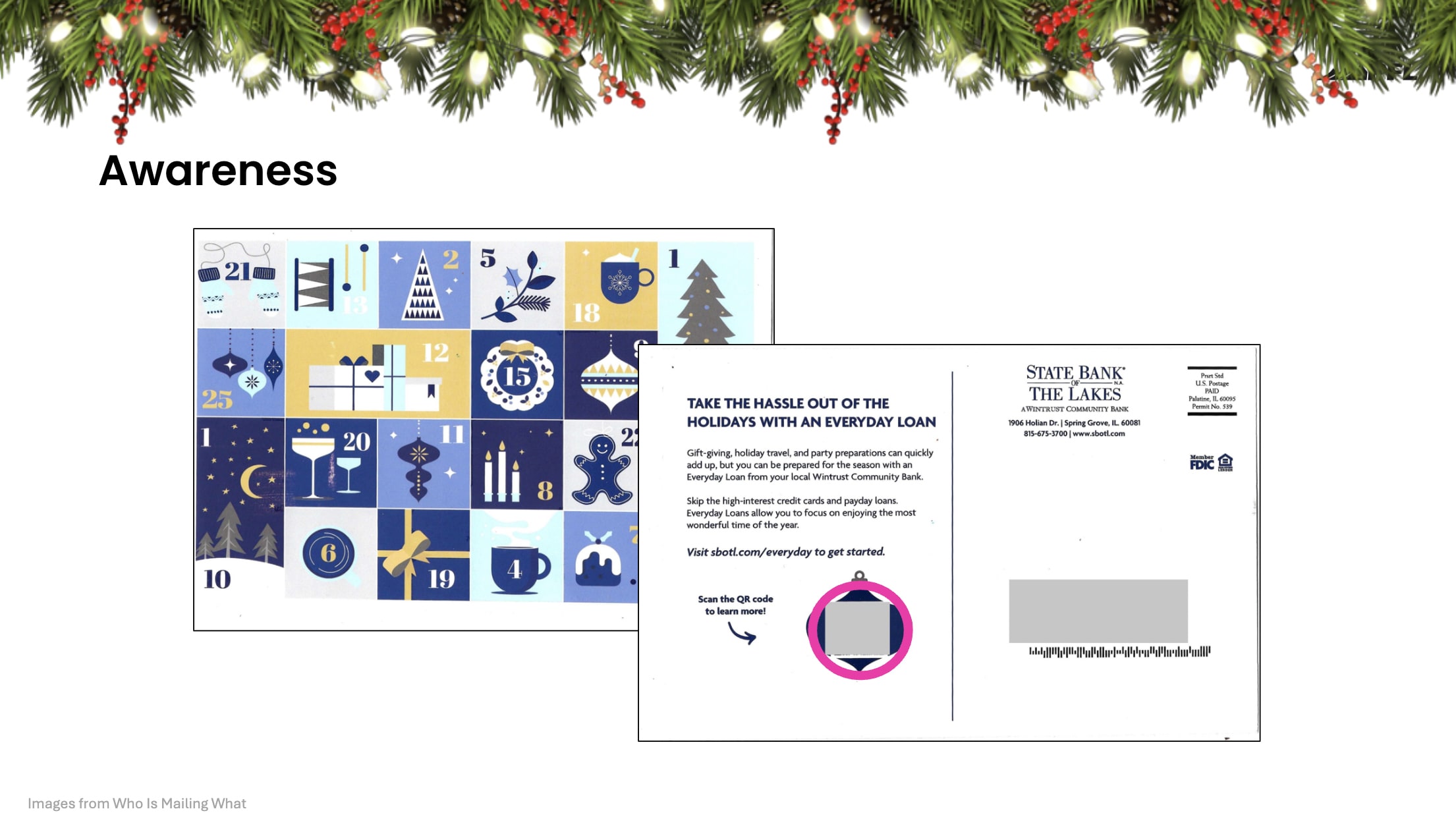
Awareness: Use bold visuals on formats such as postcards, flyers, menus, or mini catalogs to maximize reach and recognition. The Printing for Less team recommends Every Door Direct Mail (EDDM) for local targeting, allowing brands to reach every household in select areas cost-effectively. A standout example: State Bank of the Lakes sent festive, inclusive holiday mailers featuring both a URL and QR code for easy digital tracking—a simple form of A/B testing to see which channels spark the most engagement.    

Consideration: Guide buyers with educational, personalized content—think targeted letters with early offers, mini-catalogs, and postcards. One example is a fall-season letter from Modern Milkman, featuring farm partner logos, bold coupons, and an explanation of how the process works. Another one is a clever Halloween-themed payroll solution mailer that AB-tested QR codes and calls to action.  

Expert tip: Incorporate social proof such as logos or testimonials to build trust and use segmented lists for sharper targeting—supported by Printing for Less’s demographic and industry-specific data solutions.

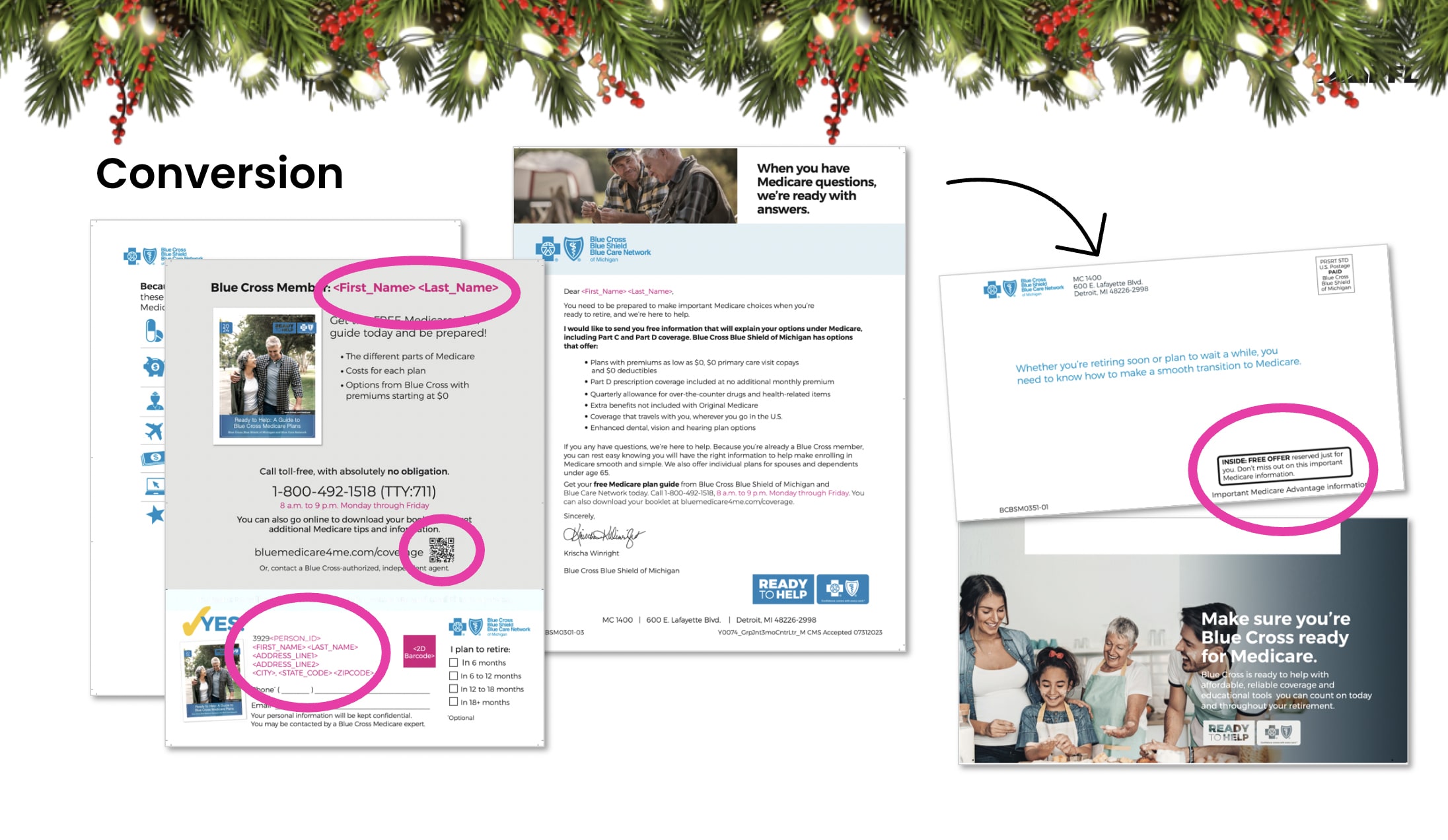
Conversion: Inspire prospects to act with personalized letters, impactful postcards, and substantial catalogs. Gray showcased Blue Cross Blue Shield’s campaign using variable data printing, QR codes, and tear-offs, all of which ensures that recipients feel known and provides several easy paths to respond. For e-commerce brands, an abandoned cart postcard with exclusive offers can nudge nearly converted shoppers over the line.  

Expert tip: Direct mail works exceptionally well as a decisive follow-up tool—especially after trial windows or cart abandonment.

Customer: A heartfelt thank-you note—say, a holiday card sent to animal shelter donors—reinforces wise purchase decisions and starts building an emotional connection right away. The power of a true signature (whether real or expertly printed) shouldn’t be underestimated in making new customers feel valued.    

Expert tip: Include a loyalty offer or referral incentive with each welcome, giving excited customers a reason to advocate.

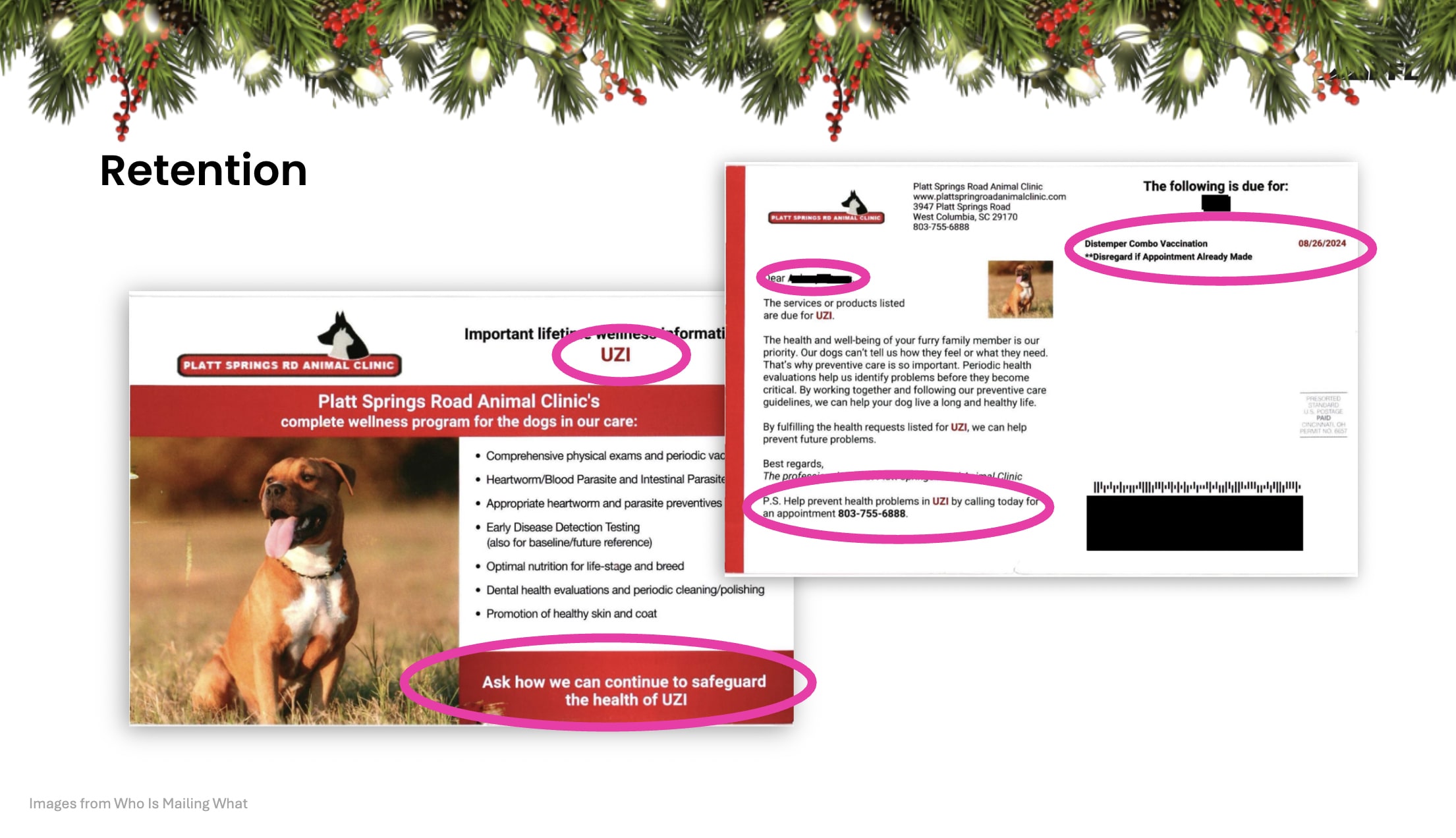
Retention: Personalized wall calendars, gift mailers, and greeting cards keep relationships warm. Gray noted her favorite: A custom postcard featuring the customer’s pet, using variable image printing and bold calls to action. Retailers can take a page from Macy’s gold star program—VIP perks and personalized coupons go a long way.

Expert tip: Personal touches, especially handwritten notes or tailored graphics, foster lasting loyalty.

Advocacy: Transform happy customers into true advocates. Phillips described Printing for Less’s own brand ambassador kits—bubble mailers with event gear, timely guides, and surprise gifts—that prompt social sharing and reaffirm brand value. Timing these thoughtful touches around renewals or major milestones keeps excitement high and engagement rolling.

Top Takeaways for Holiday Direct Mail

The two Printing for Less direct mail experts concluded that direct mail cuts through digital . Creative formats and integrated tracking make campaigns tangible, memorable, and easy to attribute. And that personalization matters more than ever. Custom messaging, variable printing, and digital integration (QR codes, URLs) turn mailers into conversion powerhouses.

The also urged attendees to integrate offline and online tactics. The most effective campaigns are those in which direct mail amplifies and tracks alongside digital marketing—using geographic data, A/B tests, and omnichannel ideas.

And when asked about the single most impactful customer journey stage, Phillips emphasized that awareness is especially powerful if a brand is looking to expand reach, but “personalized outreach for existing customers is equally valuable for building repeat engagement.”

Phillips further recommended that, to maximize ROI, planning ahead with unique URLs, QR codes, and UTM tracking is essential so marketers can see which channel or channels deliver the best results.

Coming Up!

Now Is the Perfect Time to Start Prepping You Holiday Gifting Strategy For 2025

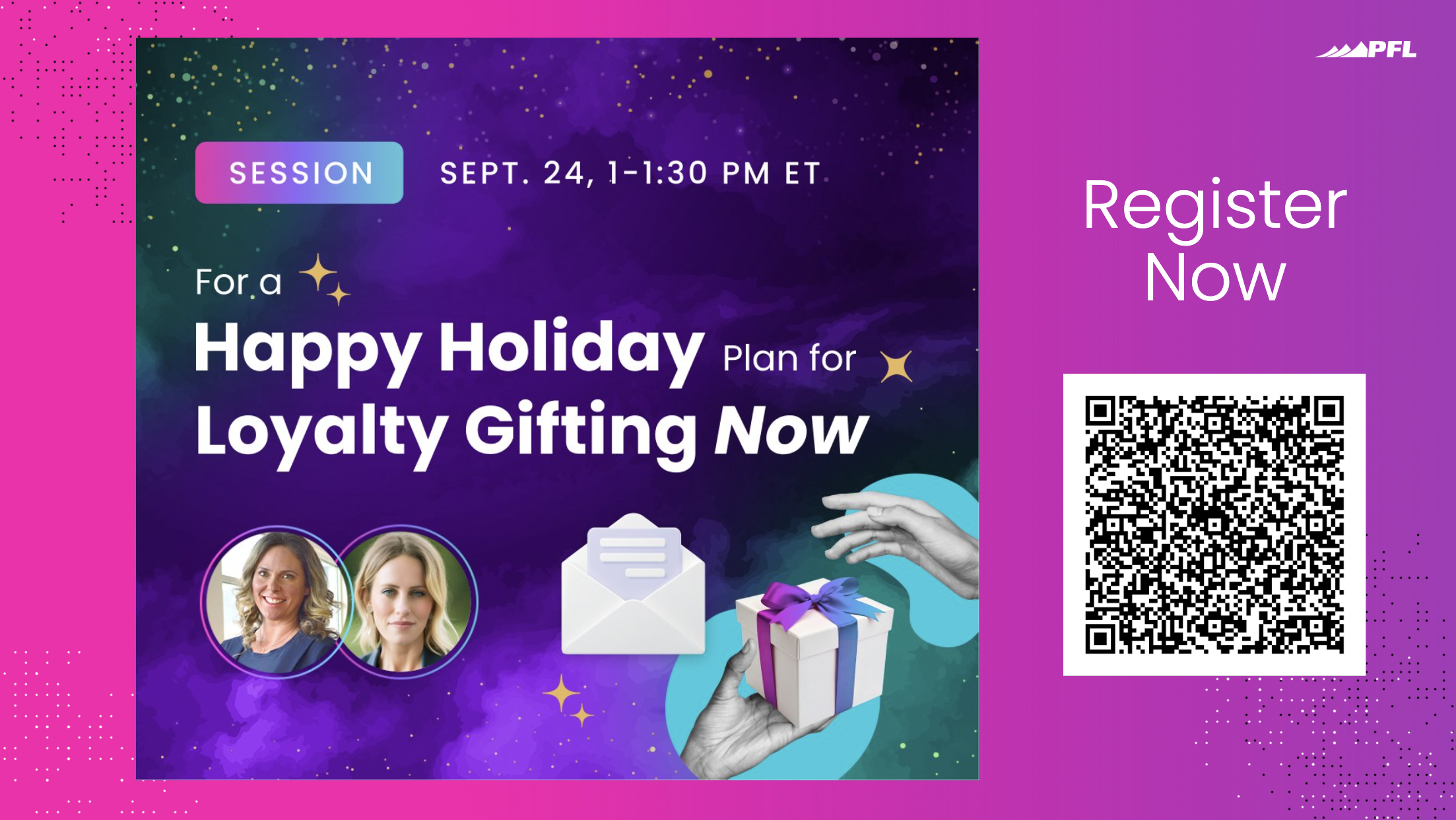
In this virtual session, we’ll explain why now the perfect time is to get going with your direct mail loyalty gifting strategy for the 2025 holiday season—and how to do it with a bang. Join Amber Sikkink, Director of Merchandising & Creative Services , Printing for Less, and Kricia Storms, Director, Product Marketing, Customer Engagement to learn why—with consumer expectations shifting, mailboxes filling up, and production timelines tightening—brands that want to see some real success this holiday season need to start planning now. 

Save Your Spot Today
Wednesday, September 24, 2025

1:00 – 1:30 PM Eastern Time
For a Happy Holiday, Plan for Loyalty Gifting Now

Tracking Direct Mail ROI: Expert Guidance from Industry Leaders

Tracking Direct Mail ROI: Expert Guidance from Industry Leaders

By The Printing for Less Team

In an era where marketing budgets are scrutinized and every dollar must be justified, understanding the true return on investment (ROI) of direct mail campaigns is more critical than ever. This was the focus of a recent virtual session, “Show Me the Money: How to Track the ROI of Your Direct Mail Campaigns,” hosted by Kristina Gray, Printing for Less Marketing Events Manager, and featuring insights from Brent Alexander, Printing for Less VP of MarTech Sales, and Jordan Haugan, Printing for Less VP of Customer Success. Drawing on more than thirty years of combined expertise, the presenters offered a roadmap for marketers eager to prove—and improve—the value of their direct mail efforts.

Why Direct Mail Still Matters

Kristina Gray opened the session by emphasizing the speakers’ deep experience in commercial printing, mailing, and customer success. “This group has a deep knowledge of all aspects of commercial printing and mailing. What’s more, our customer success team really does work as an extension of your marketing team to ensure that you are meeting the goals that you want to hit.”

Jordan Haugan observed that direct mail is often still siloed as a traditional or offline channel, even though it remains one of the most strategic tools for brands. She suggested a more integrated approach: “By putting the customer at the center of marketing efforts, we can view direct mail through the same lens used to manage other paid media channels. This allows you to allocate dollars across those channels appropriately.” This shift, she explained, enables marketers to make smarter, more holistic budget decisions—especially when faced with cuts.

Building a Data-Driven ROI Framework

Stressing the importance of learning from past campaigns, Brent Alexander outlined the foundational steps for measuring direct mail ROI. “You want to make sure you are comparing and utilizing data from the past,” he explained. “What worked previously? What kind of calls to action did you see the most success with? You really want to pull any of that data that you have to help inform the strategy and the direction that you’re going to take when you’re building out direct mail with ROI in mind.”

He further cautioned that, while the basic ROI formula—net profit divided by investment cost—seems simple, the real challenge lies in accounting for all campaign inputs, from creative and postage to list acquisition and omnichannel integration. He encouraged marketers to define clear campaign objectives, whether focused on acquisition, reactivation, cross-sell, or retention, noting that “ROI can look a little bit different depending on the objective of the particular campaign.”

The Key to Accurate Measurement

Haugan took the discussion deeper, explaining that attribution models are at the heart of understanding direct mail’s true impact. “Attribution can make or break your understanding of your direct mail performance,” she told the group, “and it’s critical to assign the value to the right touchpoint.” She described several models—including matchback, holdout, and multitouch—and recommended combining them for a more nuanced view: “A strong approach, honestly, would combine a combination of these,” she said. “So, you’re using matchback for directional data, holdout for incrementality, and multitouch to understand the multichannel context.”

To support robust attribution, Haugan further suggested also using some practical tactics, such as personalized URLs, QR codes, unique promo codes, dedicated call tracking numbers, and CRM tagging. These tools, she explained, enable marketers to connect direct mail touches to actual outcomes, even in complex, multichannel journeys.

Customer Value and Long-Term Impact

Alexander emphasized that a true understanding of ROI requires looking past immediate revenue. “You should look to incorporate conversion rate, customer acquisition cost, and lifetime value of that customer,” he noted. “Each is going to play a critical role in painting a complete and accurate picture of direct mail ROI, especially when you’re justifying long-term investments comparing direct mail to any other channel that you’re using.”

The importance of every campaign beginning with clear performance benchmarks and KPIs was also discussed. “When standing up a campaign,” said Haugan, “it’s critical that you set performance goals and KPIs for a few reasons. One, it justifies budget based on educated guesses and/or past performance. Two, you benchmark to measure campaign performance against something to determine if a campaign was successful or not. And then, three, it provides clarity for tactics and primary objectives that will be deployed and or measured.”

She encouraged marketers to work backward from revenue goals, consider factors such as audience type and campaign format, and continuously evaluate results. “Evaluate early and evaluate often,” she advised. “The goal should be to keep what is working as your baseline; continue to optimize through continuous testing of format types, messaging, segmentation of the audience and the cadence; and sunset what isn’t efficient or effective.”

“Show that you have a plan for measuring performance,” concluded  Haugan, “including what attribution model you will use, what the leading indicators will be, key milestones, and the duration you’ll measure the campaign.”

By following these expert strategies, marketers can confidently measure, defend, and optimize their direct mail investments—ensuring this venerable channel remains a vital part of the modern marketing mix.

Overcoming Common Challenges

In the Q&A session at the end of the event, the participants , where the speakers addressed practical concerns:

  • On justifying direct mail’s higher cost: “You must prove that direct mail justifies cost using ROI calculations, that’s going to be the best way to do that,” said Alexander. “Leadership wants results, and the cost associated with that just have to be proven.”
  • On tracking calls from direct mail: Both experts recommended using unique codes or phone numbers tied to each campaign or segment, allowing for precise attribution.
  • On personalization versus broad reach: “If you’re trying to build product awareness or brand, then you want to send to the masses and have less personalization, explained Alexander. “But if you’re trying to do lifecycle or retention marketing, or just trying to get a meeting, then you want to focus in on hyper personalization and not volume.”

Put Holiday Direct Mail Marketing on Your To-Do List

Put Holiday Direct Mail Marketing on Your To-Do List

By The Printing for Less Team

The start of the holiday marketing season isn’t Thanksgiving—it’s right about now. If you want to make a real impact, it’s time for you and your team to plan and act as early as possible. The months between Halloween and the New Year present a golden window to spark customer engagement and boost sales. But the time for action starts today.

Holiday direct mail, when done right, brings the surprise and delight of a physical connection in a crowded and fatigued digital world. To grab attention (and market share), you’ll need creativity, data, and the right timing.

These tips will help marketing managers, retail teams, and small businesses craft unforgettable direct mail campaigns that make the holidays—and your results—shine.

Popular Types of Holiday Direct Mail

During the festive season, people are more receptive to physical mail. It’s the perfect moment to send greetings, promotions, and special offers. Done well, direct mail drives online and in-store visits, deepens brand loyalty, and delivers impressive ROI.

Popular Types of Holiday Direct Mail

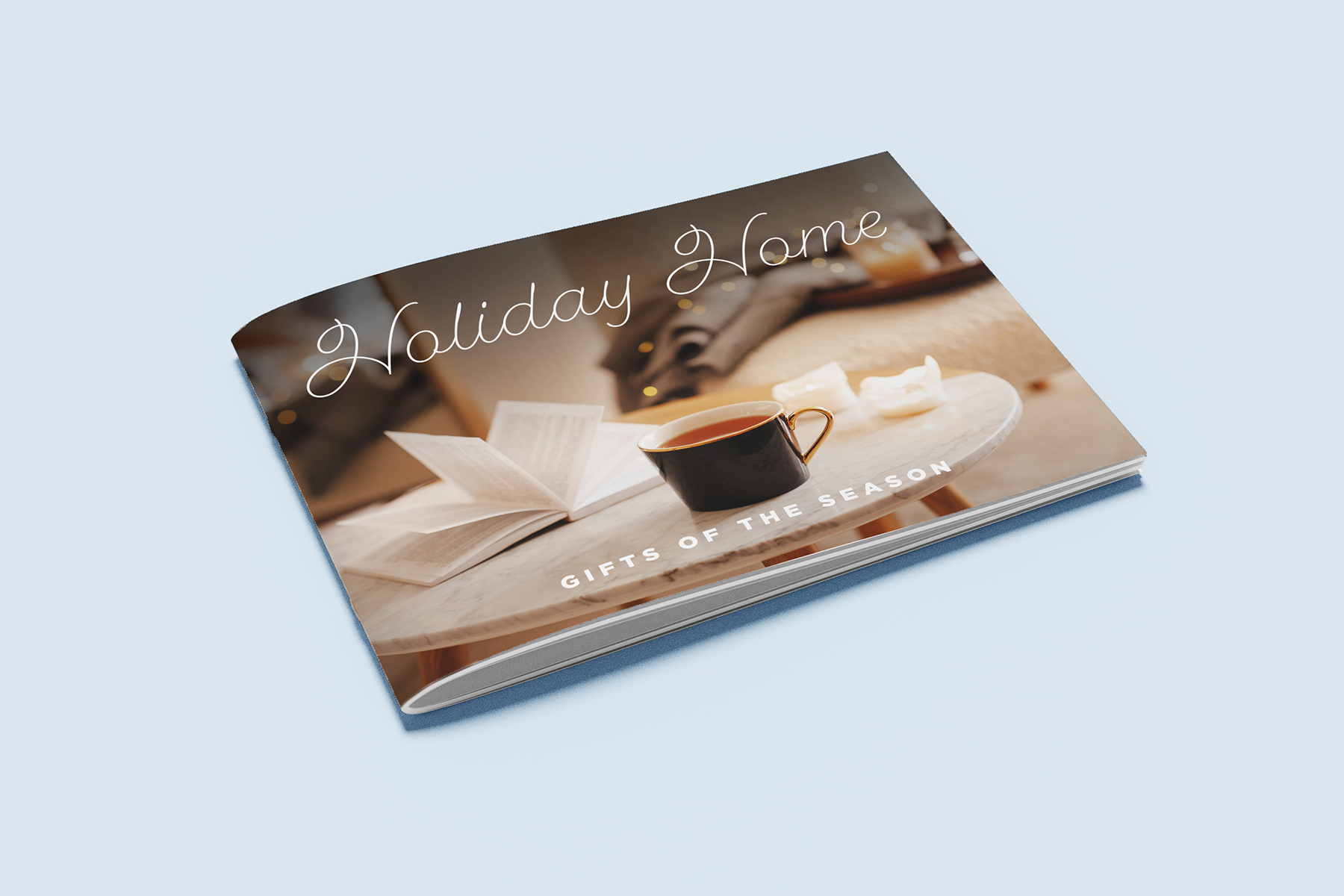
Holiday Catalogs
Showcase your bestsellers and new arrivals with a well-designed catalog. Holiday catalogs become part of the home landscape, staying visible throughout the season and keeping your brand top-of-mind.

Personalized Greeting Cards
Create authentic connections with customized holiday cards. A handwritten note or signature signals genuine appreciation, inspiring loyalty and positive sentiment.

Gift Guides
Help customers shop with curated gift guides. Segment by audience, price point, or interest, and include a mix of popular and unique products for maximum appeal.

Postcards

Postcards
Simple, versatile, and cost-effective. Use postcards to announce flash sales, share promo codes, or spread holiday cheer—they’re quick to create and deliver.

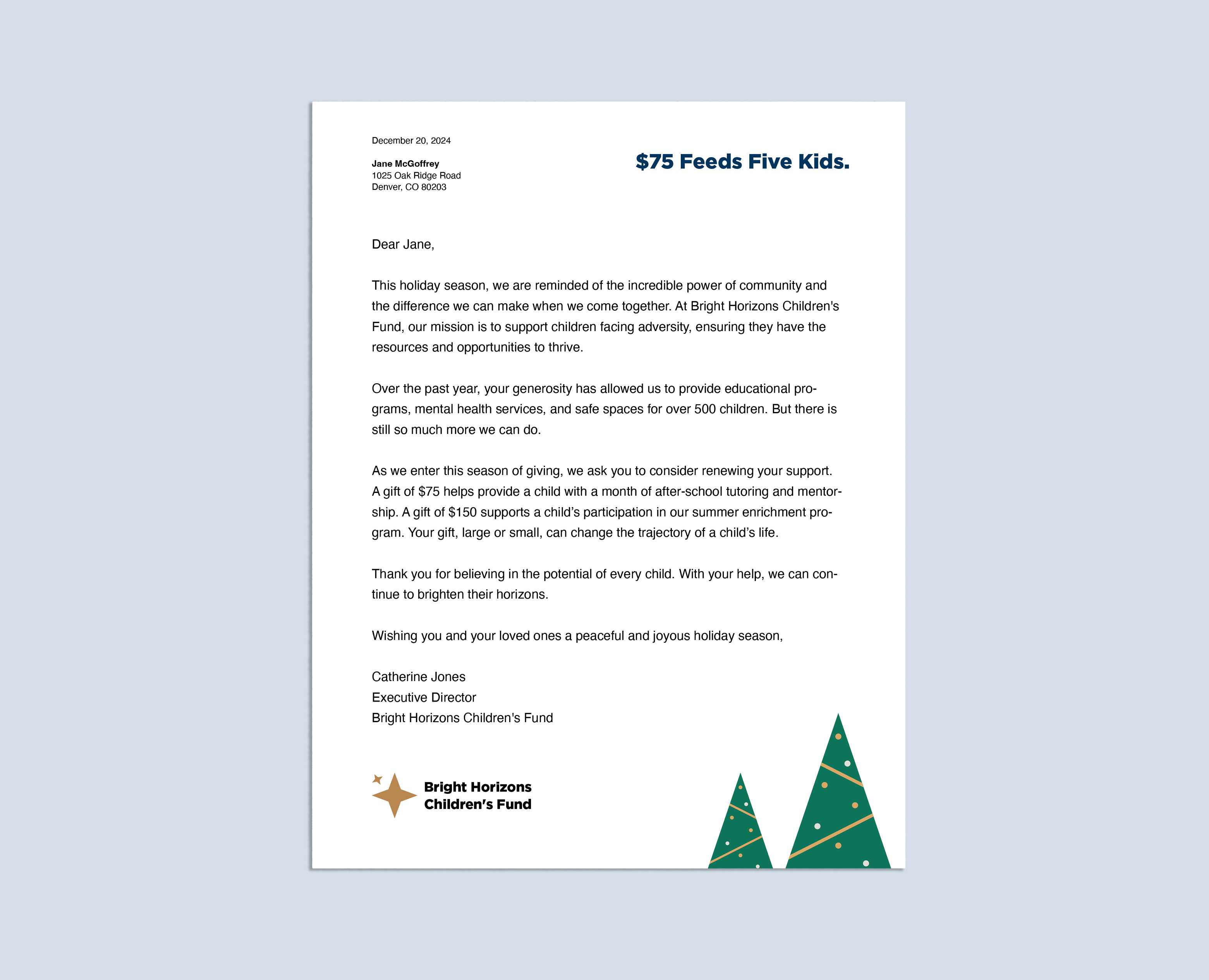
Special Offers, Coupons, Letters
Send exclusive coupons and time-limited bundles inside festive letters. Personalization and urgency can lead to immediate action.

Make Your Holiday Mailers Stand Out
The holidays invite boldness and innovation. Here are ways to make your direct mail impossible to ignore:

Interactive Elements
Pop-up designs, pull-tabs, or scratch-offs add playful engagement and boost brand recall.

Deep Personalization
Use your data to go further than a name—tailor offers and messaging based on preferences or past purchases to make customers feel truly seen.

Festive Design

Festive Design
Use high-impact visuals, seasonal colors, and premium printing to capture holiday spirit and elevate brand perception.

Clear Call-to-Action (CTA)
Every mail piece needs a CTA: Visit your store, redeem a code, sign up. Make the next step irresistible.

Sustainable Choices
Eco-friendly materials show your environmental commitment. Highlight this in your messaging—many consumers choose brands that care about the planet.

Integrating Digital: Amplify Your Reach

Modern campaigns combine the tangible impact of direct mail with the reach of digital channels. Integrate QR codes or personalized URLs in holiday mailers to drive recipients online. Support your offers with email, social, and digital ads for a unified omnichannel experience.

Best Practices for Holiday Direct Mail Success

Start Early
Begin campaign planning now to allow time for design, printing, and shipping—avoid the holiday rush.

Test and Refine
Run A/B tests on layouts, messages, and offers for continuous improvement.

Track Your Results
Use unique codes, QR links, and analytics to measure success and guide future mailers.

Follow Up
Stay engaged after the season—send a thank you, new offer, or survey in January to keep relationships going.

Implement even a few of these strategies, and your holiday direct mail campaign will not only capture the joy of the season—it’ll drive lasting sales and connections. Let direct mail be your secret weapon for a standout 2025 holiday!

It’s a Gift: How to Add Direct Mail to Holiday Campaigns

It's a Gift

We’ll cover proven tactics, budget-friendly ideas, and real-world examples to help you align your print and digital efforts for greater impact.

You’ll walk away with:

  • Smart ways to add direct mail to your holiday campaigns.
  • Tips for timing, messaging, budgeting, and measurement.
  • Inspiration from brands that are doing innovative things.

Whether you’re new to direct mail or a seasoned pro, this session will help you deliver holiday campaigns that connect—and convert.

Bonus: All attendees will receive a downloadable 2025 “Direct Mail Holiday Prep Checklist.”    

The Postcards Are Coming! The Postcards Are Coming!

The Postcards Are Coming! The Postcards Are Coming!

By The P F L and Printing for Less Teams

Imagine if Paul Revere—America’s original midnight messenger—had another way to raise the alarm back in the early days of the country. Rather than racing from town to town on horseback with a lantern, he and the boys could have blanketed the colonies with a single, well-designed postcard sent, via “Every Gate Direct Mail” (EGDM), to all the homes in Middlesex County. No missed cottages. No confusion. Just one clear, urgent message in the pigeonhole: “The British are coming!”

Silly, of course. The USPS wasn’t even established until a few months after Paul’s ride, in July of 1775, at the Second Continental Congress. But, today, there are quite a few tools available to reach the right people, at the right time, with the right message. Prompt and timely communications are as important today as ever.

That’s where modern direct mail comes in—and solutions like the real USPS’s Every Door Direct Mail (EDDM). Whether you’re warning of an impending mosquito invasion or announcing an Independence Day sale, direct mail ensures that your message lands where it matters most: In your audience’s hands.

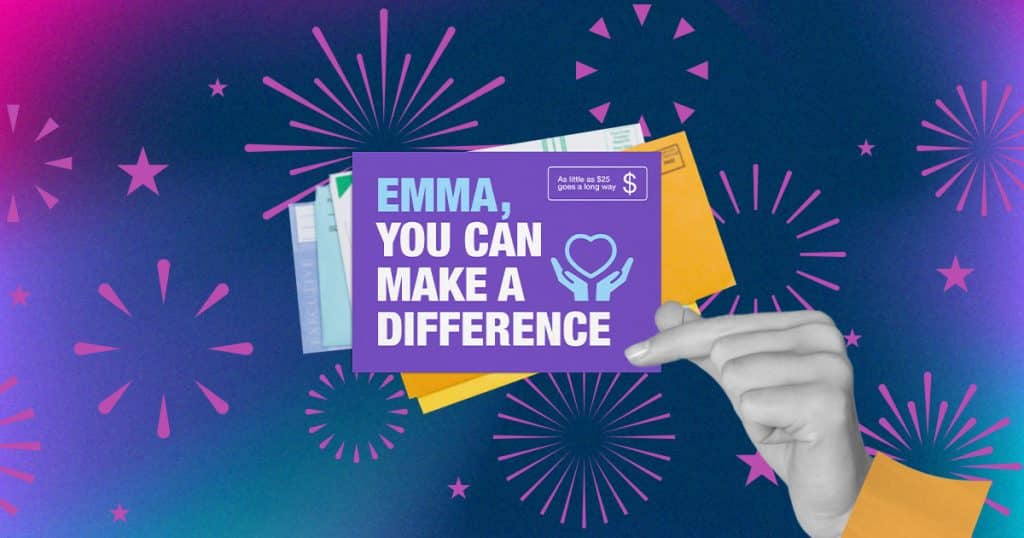
Let Your Message ‘Bang’ Like Fireworks

Just as fireworks command attention and create memorable moments, powerful direct mail pieces break through can make its own kind of messaging noise. Think of your direct mail campaign as your brand’s moment to shine—creating something tangible, memorable, and impossible to ignore. When your audience receives a physical piece that stands out, it creates that “wow” moment that digital communications often miss. Here’s how to make your direct mail campaigns explode (in a good way):

  • Design for Impact: Use bold colors and enticing imagery that instantly capture attention. A well-designed mail piece stops recipients in their tracks, much like a brilliant fireworks display against the night sky.
  • Personal Touches: Direct mail allows for personalization that digital often can’t match—add a recipient’s name, tailor offers to their interests, or include custom maps or images relevant to their location.
  • Compelling Calls to Action: The most effective direct mail, like the most impressive fireworks finales, leaves the audience knowing exactly what to do next—whether that’s visiting a store, calling a number, or scanning a QR code.  

Modern Marketers: The Power of EDDM

With the ability to target entire neighborhoods or ZIP codes, EDDM empowers businesses—large and small—to reach local audiences efficiently and affordably. It wasn’t around to help Paul Revers, but it’s the modern answer to getting important messages out to the masses, delivering stellar results.

  • Hyperlocal Targeting: Reach every household in your chosen area—no horses required. Perfect for businesses with a geographic focus, such as restaurants, retail stores, or service providers.
  • Cost-Effective Delivery: EDDM eliminates the need for a mailing list, making it one of the most affordable ways to reach a broad local audience without sacrificing impact.
  • High Visibility: Unlike crowded email inboxes where messages disappear with a swipe, a physical mail piece stands out, demands attention, and often remains visible for days or weeks.

Tips for Direct Mail Campaigns That Pop

  • Timing Matters: Plan your campaign delivery carefully—consider both seasonal relevance and your customers’ buying cycles to ensure your message arrives at the optimal moment.
  • Integrate Channels: Combine direct mail with digital marketing for maximum reach and impact. For example, send a teaser email, follow with a dimensional mailer, then reinforce with targeted social media.
  • Measure Everything: Use unique promo codes, personalized URLs, or QR codes to track response rates and calculate ROI. For more on tracking direct mail effectiveness, check out our recent digital event replay, “Show Me the Money: How to Track the ROI of Your Direct Mail Campaigns.”

Declare Your Independence From Digital

As with the declaration that sparked a nation, powerful direct mail campaigns make bold statements that demand attention. In a world where digital messages fade as quickly as they appear, physical mail endures—creating lasting impressions and driving measurable results. Want more inspiration? Explore our Resource Center for creative campaign ideas, personalization strategies, and real-world success stories from businesses that have harnessed the power of direct mail to get the word around and drive results.

  • « Go to Previous Page
  • Page 1
  • Page 2
  • Page 3
  • Page 4
  • Page 5
  • Interim pages omitted …
  • Page 47
  • Go to Next Page »

Footer

Printing for Less

info@printingforless.com
100 P F L Way, Livingston, MT 59047

800-930-2423

  • Home
  • Products
  • Services
  • Industries
  • Get Printing Samples
  • Direct Mail Marketing Resource Center
  • Printing Resource Center
  • Blogs
  • Templates
  • Terms & Conditions
  • Contact
  • About Printing for Less
  • About P F L
  • Careers
  • Login

Copyright © 1998-2025 PrintingforLess.com. All Rights Reserved.

logo
  • 800-930-2423
  • Products
  • Direct Mail Marketing
  • Services
  • Industries
  • Direct Mail Marketing Resources
  • Printing & Mailing Resources
  • Get a Quote
  • Contact Us
  • My Login
2026 Calendar
This field is for validation purposes and should be left unchanged.

Get 20% Off

Subscribe to our weekly newsletter and get an instant 20% off your first print project.

Name(Required)

*Some exclusions apply. See details