• Skip to primary navigation
  • Skip to main content
  • Skip to footer
Printing for Less

Printing for Less

At Printing for Less, we've offered high quality online printing services since 1996. Shop business cards, booklets, stickers, and more!

My LoginMy Login
800-930-2423
  • Printing
    • Postcards
    • Business Cards
    • Catalogs
    • Brochures
    • Folders
    • Letters
    • Newsletters
    • Envelopes
    • Greeting Cards
    • Print Templates
    • All Products
  • Direct Mail
    • Why Direct Mail Marketing?
    • Every Door Direct Mail® Postcards
    • Direct Mail Letters
    • Catalogs & Booklets
    • Marketing Gifts & Kits
    • Direct Mail Automation
  • Services
    • Mailing Services
    • Pro Services
    • Design Services
    • Custom Printing Services
    • Reseller Program
  • Industries
    • Advertising & Design
    • Food & Beverage
    • Healthcare Payers
    • Healthcare Providers
    • Nonprofit
    • Real Estate
    • Retail
    • Technology
    • University
  • Resources
    • Direct Mail Marketing
      Resource Center
    • Printing Resource Center
    • Blogs
    • Templates
    • Video Library
    • Have a Question?
  • Request Samples
  • Get a Quote

Blog

Roundtable Part 5: How To Level Up Your Mailbox Mojo

Expert Strategies to Optimize Direct Mail and Make Every Connection Count
By Printing for Less Team

Recently, Jennifer Bellin, CMO of Printing for Less, led a Roundtable on how to transform direct mail programs into memorable moments that bridge the gap between your brand and your audience. (Bellin was a Printing for Less customer at two previous companies, including Paycor, one of companies that took part in the event.) The expert panel shared their experience and tips for using mail to drive engagement across the customer lifecycle and foster lasting connections. The Roundtable transcript has been edited and trimmed for clarity.

We’ve broken this in-depth discussion into five parts:

  • How Did It All Start? & Priorities and Goals
  • Trends: Meaningful Connections
  • Getting Personal
  • Measure for Measure
  • Acting Mature

The other Roundtable panelists were:  

Gretchen Swann, Senior Principal Marketing Program Manager at Paycor, leverages direct mail in a highly automated and scalable way across a number of different use cases and departments.

Rob Willingham, Director of Marketing at LexisNexis, has been leveraging, testing, and refining direct mail campaigns, which target attorneys, for a number of years.

Paul Bobnak, Direct Mail Evangelist at Who’s Mailing What, has worked for more than 20 years analyzing thousands of direct mail pieces every year. He is a deep industry expert and creator and host of Meet the Mailers, a podcast series.

PART 5: ACTING MATURE

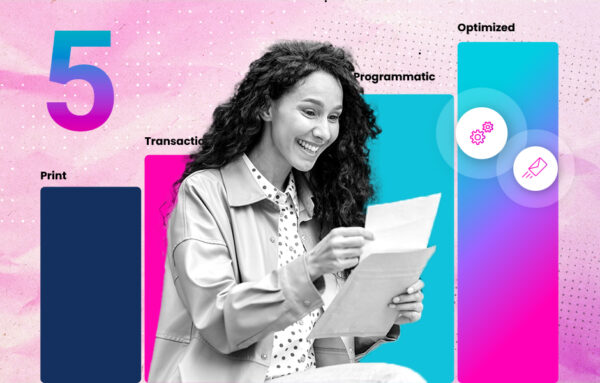
Bellin: So now let’s move to the maturity curve portion of our discussion. At Printing for Less, we are both a marketing technology company and a printing company. We work with customers across the entire direct mail maturity curve, from very basic printing and occasional mailing in stage one, all the way to stage five where programs are highly optimized, automated, and personalized across the entire organization and customer lifecycle. Then in the middle, you have transactional, operational, and programmatic stages.  

  • Transactional customers, generally work with our Printing for Less team to print and send batch-and-blast mailers via a list without integrating with our platform.   
  • Operational customers, integrate their Marketing Automation Platform with the Printing for Less Platform to execute recurring programs with basic personalization and metrics.  
  • Programmatic customers, have multiple ongoing programs across the customer lifecycle. They have triggers in their Marketing Automation Platform that notify Printing for Less when to send mail at just the right moment in the sales cycle. And they are segmenting their audiences and aligning their direct mail programs with digital and other tactics for an omni-channel approach.  
A diagram of a graphDescription automatically generated with medium confidence

Gretchen and Rob, what did your direct mail program look like at the beginning and what does it look like now? How did you move up the maturity curve?  

Swann: I definitely walked into a situation where we were doing a lot of things manually. At Paycor, we have definitely worked our way up the maturity curve, but it has taken a while. It doesn’t happen overnight. But we are getting closer to having optimized our programs. As I said, in the beginning, we were just printing items ourselves and shipping them out ourselves. We were also managing all the mail that came back because of bad addresses. Once we partnered with Printing for Less, they were able to help us make it all more scalable, which moved us up that maturity model so we could do more transactional and operational things.

We had gotten to a point where we were able to expand on the programs and start testing what we were doing. Also, we don’t typically look at direct mail as its own component anymore. We think about where we can work it into other programs and other channels as an additional touchpoint. That’s definitely helped us move up the maturity curve.  

Willingham: I really didn’t have a background on any of this, so I just walked into a situation where direct mail was a channel that I inherited and that just reps were handling. I happened to find a contract in another part of the company that wasn’t being used and I used it to help me execute personalization at scale. That’s how we were able to send a hundred packages and still make it feel personalized. But my advice is, start small, do a pilot first. And pick a specific sales team or a couple reps that are going to be open to trying marketing things, because you’re going to need them.  

SOME MATURE ADVICE

Bellin: Thanks all. Paul, what kind of advice do you have for people who are starting out and might want to move up the maturity curve?

Bobnak: I love the curve because it really reflects how direct mail has evolved in the last 15 years—this trend towards optimization at every step along the way. Just to echo what Gretchen and Rob have already said, start small, emphasize the basics, and make sure that all your data is correct and optimized the best it can be. Then begin moving out of your silos, become more multichannel, focus on specific audiences in whatever channel they are in. It can be email or other digital channels, as well. And the big one: test everything, measure everything, and then optimize from there.

Bellin: Yes, absolutely. Thank you all so much for your participation today.  Here are a few of the many takeaways from our discussion:  

  • Leveraging your data to segment and personalize your mailings can have a powerful impact on your success.  
  • It’s important to create strong, timely messages and a strong CTA.  
  • There’s significant value in testing and learning as a proof of concept and then again later on to optimize your campaigns.  
  • And lastly, start with the end in mind to ensure you have the right campaign for the results you want to generate.  

And at Printing for Less we can help you with all of this, of course. We have experts and technology that can help you simplify, personalize, drive engagement, and measure results at scale.  

Roundtable Part 4: How To Level Up Your Mailbox Mojo

By Printing for Less Team

Recently, Jennifer Bellin, CMO of Printing for Less, led a Roundtable on how to transform direct mail programs into memorable moments that bridge the gap between your brand and your audience. (Bellin was a Printing for Less customer at two previous companies, including Paycor, one of companies that took part in the event.) The expert panel shared their experience and tips for using mail to drive engagement across the customer lifecycle and foster lasting connections. The Roundtable transcript has been edited and trimmed for clarity.

We’ve broken this in-depth discussion into five parts:

  • How Did It All Start? & Priorities and Goals
  • Trends: Meaningful Connections
  • Getting Personal
  • Measure for Measure
  • Acting Mature

The other Roundtable panelists were:  

Gretchen Swann, Senior Principal Marketing Program Manager at Paycor, leverages direct mail in a highly automated and scalable way across a number of different use cases and departments.

Rob Willingham, Director of Marketing at LexisNexis, has been leveraging, testing, and refining direct mail campaigns, which target attorneys, for a number of years.

Paul Bobnak, Direct Mail Evangelist at Who’s Mailing What, has worked for more than 20 years analyzing thousands of direct mail pieces every year. He is a deep industry expert and creator and host of Meet the Mailers, a podcast series.

PART 4: MEASURE FOR MEASURE

Bellin: What great stories. Thank you for sharing all of those. Now let’s transition into measuring. A common misnomer is that direct mail isn’t measurable. I hear that all the time. But it’s far from true, especially if you have the right technology and the right tactics. Then you can make it very measurable. So, Paul, from your perspective, what are some ways that marketers can measure the performance of their direct mail campaigns?

Bobnak: Well, Jennifer, direct mail is the original direct response medium. For years, the options available were mail or maybe phone for replies to offers. Technology has changed all that, especially in the era of mobile devices. Today there’s phone-tracking software, there’s PURLs, there’s basic URLs, and of course my favorite, QR codes. Unfortunately, it took the pandemic to get people to use QR codes, to understand how to position them properly on a direct mail piece.

Bellin: You’re absolutely right. Gretchen, Rob, how do you measure the impact of your direct mail?

Swann: From our perspective, Salesforce is basically the CRM system for all of our campaigns. We actually are able to do some pretty good tracking when it comes to the impact of our direct mail programs on bottom-line results. We’re able to track how many appointments the reps were able to schedule from those different campaign responses, and then, ultimately, the bookings. We can also pinpoint the dollars we get from them, which gets us to a pretty clear ROI number for our direct mail programs.

Willingham: We’ve just recently integrated with our CRM, so we’ll have some of those campaign member attribution pieces going forward when we send out campaigns with direct mail.  

I do what’s called a “reverse pilot.” Early on when I did a pilot, I would say, okay, I’m going to take a small state or segment a hundred accounts and work with sales. I’d ask, “Okay, how are you defining success? What does success look like?” They would tell me, “We want an opportunity each.” So, I sent 82 packages out and I did a little personalization. With this pilot I got five opportunities in two weeks with average order value (AOV ) of about thirty to fifty thousand dollars. I could forecast what it was going to look like, and that was the basis of how I proposed to leadership. If I go national with this kind of program and send to a thousand accounts and my conversion rate stays the same, well, you can imagine what would happen.

After you do this a few times, you get a good baseline for your industry or customer. Here’s the formula: “number of opportunities it’s going to create” multiplied by “the AOV” multiplied by “your win rate.” That should forecast your revenue. And then you compare that revenue projection against your all-in costs, and that’s where you get ROI. So that’s a way to measure it if you don’t have everything integrated into Salesforce.

Swann: Interesting. I’ll quickly build on that for those of you who might be measuring some of this within a Salesforce or a CRM. We definitely rely on A/B testing, too. Even though we’re able to track each campaign response back to a direct mail piece, I still want to have a broader understanding. Since we’re using so many other channels beyond direct mail, we want to know if that direct mail piece, itself, is having an impact on those deals closing or getting that appointment. We also do testing. We have a list of criteria for which people will qualify to receive a direct mail. I’ll have half of the people who qualify receive it and half not. Then we are able to measure whether the people who received the direct mail piece generated more appointments for sales and did that, ultimately, also lead to better close rates?

And what’s interesting is, the couple of times we’ve done those tests, we really saw a consistent increase across the board. We see an increase in both the number of appointments we’re able to generate, plus what the increase was in the close rates. That’s helped us build a strong case to increase investment in direct mail because we were showing that, though we have other channels to communicate through, being able to integrate that direct mail component really made an large impact across the board for pipeline generation.  

And at Printing for Less we can help you with all of this, of course. We have experts and technology that can help you simplify, personalize, drive engagement, and measure results at scale.  

Want to learn more? Set up a time to meet.  

Roundtable Part 3: How To Level Up Your Mailbox Mojo

By Printing for Less Team

Recently, Jennifer Bellin, CMO of Printing for Less, led a Roundtable on how to transform direct mail programs into memorable moments that bridge the gap between your brand and your audience. (Bellin was a Printing for Less customer at two previous companies, including Paycor, one of companies that took part in the event.) The expert panel shared their experience and tips for using mail to drive engagement across the customer lifecycle and foster lasting connections. The Roundtable transcript has been edited and trimmed for clarity.

We’ve broken this in-depth discussion into five parts:

  • How Did It All Start? & Priorities and Goals
  • Trends: Meaningful Connections
  • Getting Personal
  • Measure for Measure
  • Acting Mature

The Roundtable panelists:  

Gretchen Swann, Senior Principal Marketing Program Manager at Paycor, leverages direct mail in a highly automated and scalable way across a number of different use cases and departments.

Rob Willingham, Director of Marketing at LexisNexis, has been leveraging, testing, and refining direct mail campaigns, which target attorneys, for a number of years.

Paul Bobnak, Direct Mail Evangelist at Who’s Mailing What, has worked for more than 20 years analyzing thousands of direct mail pieces every year. He is a deep industry expert and creator and host of Meet the Mailers, a podcast series.

PART 3: GETTING PERSONAL

Bellin: Paul, what are some of the most creative things you’ve seen around personalization?

Bobnak: There are so many interesting things going on, Jennifer. It’s a testament to how much advanced technology offers to marketers today—especially with so many ways to connect with customers and prospects with variable data printing. One example is that my utility company has a smart meter that they tap into to get my energy usage. Then they create a chart showing my energy usage compared with my neighbor’s energy so people are aware. This is a multichannel campaign; they do the same thing with email. It’s really impactful when you see that graph where they chart it across the 12 months period.

Another example is a homeowner’s insurance mailing that went out to a customer who had previously inquired about getting homeowner’s insurance. It provides them all the information that’s publicly available about when their home was built and the square footage and a quote based on all that information. It really catches your attention and makes a real connection with the customer.

Bellin: Those are some really great ideas. I love the idea of comparing you to your neighbors. I’ve not seen that. One of the most rewarding things for me as a marketer is when someone reaches out to me, and they respond positively to a campaign that I’m doing. Last year we mailed out books, The Power of Moments. If you haven’t read it, it’s really awesome, by Chip and Dan Heath. One recipient reached out to me afterwards and said, “I love the book. I read it and applied the concept of ‘surprise and delight’ with a family member who had just opened a new business.” It was clear that the campaign made a memorable impact on her and it really made my day just to hear how it kind of changed her life in a really positive way. Gretchen, Rob, do you have an experience like this where a mail recipient shared a positive response with you?

Swann: Absolutely. It’s definitely great when you have a meaningful agenda and get those kinds of affirmations that what you’re doing is really working, and it’s not always about pipeline. One initiative that we have here at Paycor is called “Perspective+,” and it’s basically a resource center that’s dedicated totally to DE&I content. We have a monthly newsletter featuring the latest DE&I content that we have for that month. When we just celebrated Black History Month, for instance, we showcased a children’s book about understanding and celebrating differences between people that was written by someone at Paycor. We gave people the opportunity to sign up for the newsletter and receive the book for their children. We had such a wonderful outpouring of interest. It was really cool to be able to see how much interest we received and how much positive reaction we got when people started receiving their packages.

Willingham: In terms of corporate social responsibility, for women’s history month last year we did a campaign that included writing blogs and ads around what we’re doing in the space, as well as highlighting significant women in law in the last hundred years. We wrote those pieces and gave reps the opportunity to nominate five accounts that they wanted to gift flowers for Women’s History Month. We sent the flowers to these accounts with a message that said, “Here’s to the change makers, women in law breaking barriers, creating progress and shaping an equitable world in honor of Women’s History, LexisNexis.”

So, this was less about my product and more around being part of my tribe because sometimes people want to be associated and connected with brands and companies that are pursuing and engaging in things that matter to them on a social and personal level. One of the surprising moments was when some of the recipient attorneys started sharing on LinkedIn, saying, “Hey, I just got flowers and not from my husband,” and they would post the notes from LexisNexis. It was very cool.

And at Printing for Less we can help you with all of this, of course. We have experts and technology that can help you simplify, personalize, drive engagement, and measure results at scale.  
Roundtable Part 2: How To Level Up Your Mailbox Mojo

Roundtable Part 2: How To Level Up Your Mailbox Mojo

By Printing for Less Team

Recently, Jennifer Bellin, CMO of Printing for Less, led a Roundtable on how to transform direct mail programs into memorable moments that bridge the gap between your brand and your audience. (Bellin was a Printing for Less customer at two previous companies, including Paycor, one of companies that took part in the event.) The expert panel shared their experience and tips for using mail to drive engagement across the customer lifecycle and foster lasting connections. The Roundtable transcript has been edited and trimmed for clarity.

We’ve broken this in-depth discussion into five parts:

  • How Did It All Start? & Priorities and Goals
  • Trends: Meaningful Connections
  • Getting Personal
  • Measure for Measure
  • Acting Mature

The Roundtable panelists:  

Gretchen Swann, Senior Principal Marketing Program Manager at Paycor, leverages direct mail in a highly automated and scalable way across a number of different use cases and departments.

Rob Willingham, Director of Marketing at LexisNexis, has been leveraging, testing, and refining direct mail campaigns, which target attorneys, for a number of years.

Paul Bobnak, Direct Mail Evangelist at Who’s Mailing What, has worked for more than 20 years analyzing thousands of direct mail pieces every year. He is a deep industry expert and creator and host of Meet the Mailers, a podcast series.

TRENDS—MAKING MEANINGFUL CONNECTIONS

Bellin: We all agree it is becoming harder and harder to get attention with email. We all use email and other digital tactics. But I recently read a study that said 82 percent of marketers are increasing their direct mail budget this year for that very reason. Paul, how have you seen direct mail evolve? What are some of the trends you’re seeing?

Bobnak: One thing we’ve noticed at Who’s Mailing What in the last couple of years is a shrinkage of mail formats.  Companies that had been mailing large flats or envelope packages are moving to folded self-mailers. Or companies that mailed self-folded self-mailers are moving to smaller folded self-mailers or jumbo postcards. In some cases, it’s all about the postage, but in a lot of cases it’s about the availability and cost of materials. This is part of the general trend of companies trying to do things smarter and optimize every piece.

Bellin: Yeah, we’ve definitely seen that with postcards. We’re sending more postcards ourselves, and a lot of our customers are as well, because you can still make a stunning, visually appealing piece with a postcard. You can still personalize it and it is a lot more affordable. Rob, Gretchen, how are you creating those meaningful connections with direct mail through the customer life cycle?  

Willingham: My ideal customer profile is attorneys, so my challenge was: What am I going to give to a lawyer that they don’t already have, they haven’t seen, or they can’t afford? What am I going to possibly give that’s unique? What I realized is that it’s not always about the item, but about how you leverage it in the whole message and the whole experience to lift the campaign.

A key piece in this whole process is the digital handoff. You can use either FedEx or UPS for the trigger that will send an email to the rep saying, “Hey, this package has been delivered at this account.” That’s such a critical piece, because that’s the trigger for the rep to then follow up within the sweet spot of 48 to 72 hours. Overall, it’s all about trying to surprise customers and prospects, preferably using seasonal gifts or something they might not have seen before. This helps to create meaningful connections along the way.

Swann: I absolutely love that. At Paycor we do something similar. We’ll send alerts to sales when things have been delivered and we try to not just use direct mail as its own channel. We like to integrate it with other channels as well. Once the direct mail piece has been marked as delivered, most time we’ll have an email sent to the prospect as well saying, “There’s something waiting for you in your mailbox.” This lets them continue that journey wherever there are, and we can have consistent messaging across all different touch points.

Many of the programs I started out with were centered on the customer journey. A lot of the nurture programs that had been running for years were just email. What I started to do was think about where it would make sense to integrate a direct mail component. What’s great about thinking about how to integrate the direct mail pieces into these nurtures is that, once we’ve figured out how to do it, they’re always on. Once we turn them on, we’re able to watch the results come in and optimize as needed. This allows me to then move on to other programs.

On the other hand, as Rob was saying, we also try to think about fun thematic campaigns we can do that are more of a one-off thing. One example is a webinar series just in February based on “tough love”— kind of playing off of the Valentine’s Day theme coupled with the tough conversations HR leaders might have to have with some employees. To promote that series, we put together a fun little Valentine’s package that had some Sour Patch Kids that came in a little box, like what might see kids hand out in the classroom that say “to” and “from.” We sent those out to people inviting them to the webinar series. We definitely did some variable printing here to put in people’s first names when applicable—anything we could do to customize it. We really wanted to help them understand that we’re not just sending the same thing to everybody. We’re really trying to make it specific to them to make prospects feel a little more special and grab their attention.

And at Printing for Less we can help you with all of this, of course. We have experts and technology that can help you simplify, personalize, drive engagement, and measure results at scale.  

Connect and Delight Across the Customer Lifecycle: Reinforce Your Campaigns with Direct Mail

Connect and Delight

Discover how to integrate direct mail into your marketing mix to strengthen customer relationships and boost brand loyalty. Learn how direct mail can be a powerful tool at every touchpoint in the customer journey, from acquisition to retention.

What You Will Learn:

  • Understand the benefits of using direct mail alongside digital marketing channels.
  • Explore how direct mail can be strategically implemented throughout the customer lifecycle.
  • Discover how direct mail can foster deeper customer engagement and brand connection.
  • Learn how to measure the success of your direct mail campaigns.
  • Gain insights into best practices for crafting compelling direct mail pieces.

Want to see how Printing for Less can help you with print & mail?

Contact Us

Door Hangers: Local Business’s Key for Boosting Sales 

Door Hangers: Local Business's Key for Boosting Sales 

By The Printing for Less Team 

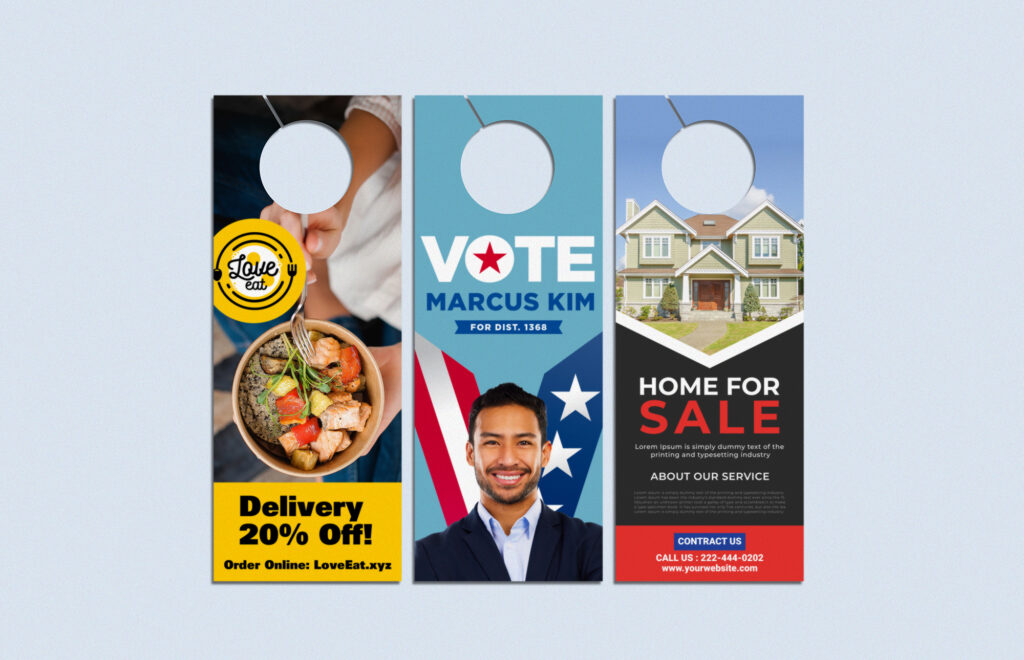
It’s not news that, in this era dominated by digital marketing, it’s easy to overlook the power of strategies such as direct mail. One direct mail-adjacent piece—an often-underrated tactic that continues to yield impressive results for local businesses—is the simple door hanger. 

Door hangers are full of untapped marketing potential. They are the perfect vehicle for marketing your business locally and are one of the most inexpensive ways to get the word out to a large group of potential customers. When strategically deployed, door hangers can be an effective tool for driving sales and increasing brand awareness in your community. Here’s how: 

  1. Hyper-targeted Marketing: Door hangers allow you to directly target specific neighborhoods or areas where your ideal customers reside. By tailoring your message to suit the needs and preferences of local residents, you can increase the relevance of your marketing efforts and capture the attention of potential customers. 
  1. High Visibility: Unlike digital ads that can easily be ignored or overlooked, door hangers are a physical element sure to be seen by homeowners as they enter or exit their homes. This high visibility increases the likelihood of your message being noticed and remembered, thereby enhancing brand recall and engagement. 
  1. Cost-effective: Compared with other forms of advertising—such as television or radio commercials—door hangers offer a cost-effective solution for local businesses with limited marketing budgets. With minimal printing and distribution costs, door hangers provide an affordable means of reaching a targeted audience without breaking the bank. 
  1. Personal Touch: In an age of impersonal digital communication, receiving a physical door hanger can make recipients feel valued and appreciated. And by incorporating personalized messages or special offers, you can establish a connection with potential customers and differentiate your business from competitors. 
  1. Trackable Results: While perhaps not widely known, the effectiveness of door hanger campaigns can be easily measured using various tracking methods. By including unique promo or QR codes on your door hangers, you can accurately monitor the success of the campaign and determine its return on investment. 
  1. Versatility: Door hangers are highly versatile marketing tools that can be customized to suit a variety of promotional objectives. Whether you’re promoting a grand opening, announcing a special sale, or offering exclusive discounts, door hangers provide a flexible platform for conveying your message in a unique and memorable way. 
  1. Complement to Digital Marketing: While digital marketing plays a crucial role in today’s advertising landscape, integrating door hanger campaigns into your marketing mix can amplify your reach and reinforce your brand message. By leveraging both online and offline channels, you can create a cohesive marketing strategy that maximizes your impact and drives sales. 

Door hangers, though simple, represent a valuable opportunity for local businesses to connect with a target audience on a personal level and drive tangible results. By harnessing the unique advantages of this tried-and-true marketing method, businesses can enhance their visibility, attract new customers, and ultimately boost sales in their local community. So, the next time you’re looking for an effective way to promote your business, don’t underestimate the power of the door hanger. It could be your key to success. Want to give them a try? Shop our door hangers. 

Want to see how Printing for Less can help you with print & mail?

Contact Us

  • « Go to Previous Page
  • Page 1
  • Interim pages omitted …
  • Page 11
  • Page 12
  • Page 13
  • Page 14
  • Page 15
  • Interim pages omitted …
  • Page 48
  • Go to Next Page »

Footer

Printing for Less

info@printingforless.com
100 P F L Way, Livingston, MT 59047

800-930-2423

  • Home
  • Products
  • Services
  • Industries
  • Get Printing Samples
  • Direct Mail Marketing Resource Center
  • Printing Resource Center
  • Blogs
  • Templates
  • Terms & Conditions
  • Contact
  • About Printing for Less
  • Careers
  • Login

Copyright © 1998-2026 PrintingforLess.com. All Rights Reserved.

logo
  • 800-930-2423
  • Products
  • Direct Mail Marketing
  • Services
  • Industries
  • Direct Mail Marketing Resources
  • Printing & Mailing Resources
  • Get a Quote
  • Contact Us
  • My Login
Direct Mail Delivery
This field is for validation purposes and should be left unchanged.

Get 20% Off*

Your First Print Order

Name(Required)

*By subscribing, you agree to receive weekly emails from Printing for Less. Some exclusions apply. See details.