• Skip to primary navigation
  • Skip to main content
  • Skip to footer
Printing for Less

Printing for Less

At Printing for Less, we've offered high quality online printing services since 1996. Shop business cards, booklets, stickers, and more!

My LoginMy Login
800-930-2423
  • Printing
    • Postcards
    • Business Cards
    • Catalogs
    • Brochures
    • Folders
    • Letters
    • Newsletters
    • Envelopes
    • Greeting Cards
    • Print Templates
    • All Products
  • Direct Mail
    • Why Direct Mail Marketing?
    • Every Door Direct Mail® Postcards
    • Direct Mail Letters
    • Catalogs & Booklets
    • Marketing Gifts & Kits
    • Direct Mail Automation
  • Services
    • Mailing Services
    • Pro Services
    • Design Services
    • Custom Printing Services
    • Reseller Program
  • Industries
    • Advertising & Design
    • Food & Beverage
    • Healthcare Payers
    • Healthcare Providers
    • Nonprofit
    • Real Estate
    • Retail
    • Technology
    • University
  • Resources
    • Direct Mail Marketing
      Resource Center
    • Printing Resource Center
    • Blogs
    • Templates
    • Video Library
    • Have a Question?
  • Request Samples
  • Get a Quote

Blog

Direct Mail Isn’t Dead: 3 Scenarios When It Makes Sense

Direct Mail Isn’t Dead: 3 Scenarios When It Makes Sense

With the average American having almost seven hours of screen time a day, some say that digital channels have “killed” print media. But is this a fact or just an overblown myth?

Direct mail can help your nonprofit organization fundraise and engage supporters. In fact, it can be a boon for nonprofits struggling with common digital fundraising hurdles, such as intense competition, digital fatigue, credibility concerns, and deliverability issues.

Explore the full verdict and discover key scenarios when direct mail can serve as a refreshing and effective change of pace in your fundraising and marketing strategy.

The Verdict: Is Direct Mail Dead?

No, direct mail is not dead. However, it is evolving. 

Direct mail is entering a new era thanks to AI-powered personalization, integrations with channels like email, SMS, and digital media and retargeting. These innovations prime the channel to help your nonprofit overcome challenges like:

  • Intense competition. Standing out on digital channels can be a challenge when you’re competing with influencers and corporations with big budgets for your donors’ attention. With direct mail, you only have to compete with what lands in a physical mailbox to inspire generosity—plus, there is far less physical mail today thanks to paperless billing. Studies from USPS also show that Gen Z is becoming more responsive to direct mail, with 72% indicating that they would be disappointed to no longer receive mail.
  • Digital fatigue. Many people get tired of staring at screens, particularly when it comes to promotional content or fundraising appeals. Physical mail is a less stimulating alternative that offers a tactile experience for your supporters.
  • Low trust and credibility. Digital fundraising appeals can sometimes feel spammy or impersonal. Print communications, on the other hand, have a professional, trustworthy feel that is ideal for bigger fundraising asks, like contributing a major gift or joining your recurring giving program.
  • Deliverability issues. Understanding and correcting deliverability issues is a frustrating, time-consuming component of email marketing. While print mail can get lost, this is rare. As long as the address is correct, direct mail will almost always be delivered to your supporters’ mailboxes to ensure supporters actually see your appeals.

Simply put, direct mail is an excellent and often necessary complement to your digital fundraising efforts. Used together, these channels can fill in each other’s gaps and present a stronger outreach strategy that helps you deeply engage donors. 

Next, we’ll cover three scenarios in which direct mail is the most effective option in your nonprofit marketing toolkit.

Scenario 1: Establishing authority.

In the nonprofit sector, credibility is nonnegotiable. For supporters to feel comfortable donating, they must view your organization as a competent, trustworthy authority figure in your field. However, digital communications can lack the perceived “weight” of physical documents. 

Direct mail is often viewed as more permanent and official, while digital notifications may be perceived as fleeting or spammy. For example, thanking donors who contributed to your year-end fundraiser by launching a credibility-building direct mail campaign in the new year will likely feel more special than a simple text or email.

The Print Marketing Solution

  • Share physical annual reports. Send out a physical annual report to stakeholders like major donors and board members, incorporating polished graphic design elements and visuals. This signals professionalism, financial health, and organizational longevity.
  • Align with donor preferences to boost retention. Pay attention to donors’ communication preferences, and reach out via direct mail to those who prefer more formal communications (often older donors who are prospects for major gifts or planned giving). This shows that you understand and value their preferences, enhancing donor retention and engagement.
  • Focus on intentional, cost-effective outreach. Use simple mail packages with clear branding and consistent, compelling messaging. This demonstrates responsible financial stewardship to supporters while still ensuring your mission remains top of mind.

Scenario 2: Using direct mail as a key piece of omni-channel campaigns.

Of course, direct mail should not be the only channel you use to reach supporters. As AGP’s guide to omni-channel marketing highlights, this approach seamlessly integrates multiple channels to offer a personalized, layered donor experience. Omni-channel campaigns can benefit your nonprofit by building deeper relationships with donors, boosting conversion rates, maximizing your available resources, and capturing more fundraising opportunities.

As part of your omni-channel strategy, direct mail can help you grab attention outside the screen to drive more traffic to the screen. Often, donors may choose to be more generous online, meaning that connecting them to online channels could help boost revenue.

The Print Marketing Solution

  • Add QR codes to postcards. Postcards are a low-cost yet effective donor outreach option. Include a compelling image and a large, scannable QR code that links to your donation page, a video impact story, or other engaging content, like a newsletter, about your organization’s work.
  • Mail physical event materials. If you host in-person fundraising events, mail out a printed program with a QR code that attendees can scan to take action. For example, you might send out a brochure listing the most sought-after items in your upcoming auction fundraiser, prompting supporters to scan a code to view the full catalog. Maintain consistent branding across all event materials so supporters can easily connect them to your nonprofit’s identity.
  • Create a cohesive narrative. Your communications should have cohesive visuals and content. Use nonprofit storytelling to weave a common thread between each component of the campaign. For example, use direct mail to introduce a beneficiary’s challenge, then use a QR code to send donors to a landing page where they can see the resolution and donate.

Scenario 3: Targeting niche or high-value segments.

Your most generous donor groups, such as major donors, may not be active on social media or responsive to email outreach. Even if they are reachable on these platforms, a generic email blast can feel impersonal and inappropriate when asking for large gifts. In contrast, direct mail can help you convey the exclusivity and respect needed for major donor cultivation.

The Print Marketing Solution

  • Leverage professional expertise. For campaigns targeting mid-level, major gift, and planned giving audiences, consider getting help from the experts. Partnering with a specialized nonprofit direct mail marketing agency and a elevated printing company ensures your materials reflect the caliber of your mission. With their efforts and expertise, the final products that your most valuable prospects receive will feel exclusive, professional, and worthy of a significant philanthropic investment.
  • Hyper-personalize mail. Use strategies like variable data printing to create pieces that reference the donor’s specific past donations and overall impact (e.g., “Thanks to you, [Donor Name], the [Specific Project] is fully funded.”).
  • Develop capital campaign brochures, planned giving outreach, and impact reports. When launching a major fundraising campaign, produce a limited run of high-end, glossy brochures for your top 50 prospects. Additionally, you might create similar brochures to follow up after the campaign that show the impact of their donations.

Direct mail and digital media are both critically important parts of your broader marketing and fundraising toolkit. Where direct mail is ideal for building trust and deepening donor relationships, digital channels excel at speed and scale. 

To get the most out of your direct mail efforts, remember to consistently review performance metrics, audit your current funnel to pinpoint areas where you need to build trust, and ensure your nonprofit’s mission is always first and foremost in any donor communication.

Mindset Shift: 3 Tips for Marketing Your Thrift Store

Mindset Shift: 3 Tips for Marketing Your Thrift Store

Elevating your nonprofit thrift shop’s footprint requires targeted marketing strategies that simultaneously attract budget-conscious shoppers and civic-minded donors. Traditional retail strategies often fall short because they don’t tell a story that addresses the unique dual-audience model of thrift stores.

Successfully growing your brand requires blending physical outreach with specialized technology to reach community members while streamlining your back-end donation and retail workflows. This guide provides three practical marketing tips designed to help your thrift store drive retail revenue, accelerate donation streams, and deepen local community engagement.

Core principles for marketing your thrift store

Building an effective outreach framework relies on several fundamental practices:

  • Establish a cohesive brand voice that balances donor outreach with retail shopper engagement. Your messaging must seamlessly pivot between inspiring philanthropy and promoting items without diluting the core organizational narrative.
  • Develop a structured communication plan to ensure that your community members understand your overarching charitable mission. Allegiance Group + Pursuant recommends documenting processes for tying everyday store transactions to the broader societal impact your nonprofit supports to guide employees when drafting your communications.
  • Adapt a universal buyer’s guide framework to position your shop as a reliable local authority on secondhand goods. Distributing resources that teach patrons how to evaluate vintage garments or inspect solid wood furniture builds immediate consumer confidence and shows that your store is trustworthy.

Above all, a solid marketing foundation requires thrift store managers to coordinate dual messaging streams that target both regular donors and retail shoppers. Shift your core focus to impact-driven narratives by showing exactly how item purchases translate into neighborhood support programs. For instance, displaying signage that correlates average basket sizes to local meal distributions creates an immediate connection for shoppers.

Defining these underlying marketing principles before launching promotional campaigns ensures that your messages resonate with your audience.

Tip 1: Incorporate Direct Mail Into Your Outreach

Sending physical promotional materials directly to neighborhood mailboxes cuts through digital noise. This marketing strategy lands tangible touchpoints directly on kitchen counters, keeping your retail location top of mind during seasonal closet clean-outs. Using tactics like this provides thrift stores with a reliable channel to engage both local shoppers and regular donors.

Plus, there are many different types of print collateral you can send, including:

  • Letters
  • Postcards
  • Brochures and pamphlets
  • Self-mailers
  • Catalog booklets

To boost response rates, you can embed scannable QR codes on materials that direct donors to an interactive scheduling map for oversized-item pickups. This tactical link minimizes friction, helping you bring in even more donors and customers.

If you’re unsure how to handle your print marketing strategy, consider working with a dedicated commercial printing service, such as Printing for Less! Their services include design, custom printing, reselling, fulfillment, and more. Plus, they offer personalized service to ensure that the materials they print work for your audience.

Tip 2: Optimize Your Digital Presence

Although print marketing is still important, don’t neglect your digital presence. Modern thrift stores can capture a large number of shoppers online, especially those researching local sustainable shopping options. Ensuring your shop occupies prominent space in local search results converts web browsing into physical footsteps.

Expanding your web footprint involves utilizing several targeted digital strategies:

  • Maximize local search visibility to capture foot traffic from nearby shoppers looking for sustainable goods. That means optimizing your website for local search results and listing your business on Google. Keep your listings updated with accurate hours and high-resolution images of curated inventory sections to establish credibility.
  • Leverage digital advertising grants, such as the Google Ad Grant, to expand your reach without straining operational budget. These grants allow nonprofit thrift stores to gain more visibility on and drive more traffic to key pages, such as your homepage or donation pages.
  • Create automated email campaigns to nurture ongoing relationships with past shoppers by offering personalized rewards or sneak-peek access. When you send structured digital newsletters, you keep your thrift store top of mind for community members.
  • Launch geo-targeted social media video campaigns to highlight inventory drops to immediate neighborhood segments. Producing short, engaging clips of unique vintage arrivals captures the attention of local collectors who monitor social platforms for high-value merchandise.

Additionally, dedicate time to optimizing your business profile with localized keywords like “consignment alternative near me” or “vintage clothing store near me” rather than generic keywords. This targeted approach positions your storefront right at the top of map queries when shoppers are ready to browse a store like yours.

Tip 3: Create Consistent Inventory Sourcing Campaigns

Thrift stores thrive when they have reliable, high-quality merchandise streams that consistently fill their shelves and display racks. So, your marketing strategies must dedicate equal energy to donor acquisition as to customer acquisition.

Maintaining a healthy supply chain relies on several strategic procurement strategies:

  • Launch neighborhood donation drives to sustain a steady flow of high-quality items and prevent your thrift store from going empty. Coordinating these neighborhood efforts helps protect your storefront from severe inventory drops that can damage long-term customer retention.
  • Promote donation dropoff and pickup convenience to inspire donors to give. Show clear visuals of your physical dropoff lanes to reassure community members that donating is easy and won’t take too long. Plus, invest in thrift store software to simplify the process. For example, ThriftCart mentions that your point of sale (POS) solution should offer donation pickup scheduling, so community members can let you know when it’s convenient for you to pick up their items.
  • Publish precise intake guidelines to prevent staff from having to make frustrating judgment calls on unacceptable items at your loading docks. Communicating strict acceptance criteria across all digital channels helps prevent your intake warehouse from becoming a costly junk-disposal center.

It’s also a great idea to establish recurring seasonal donation drives with local corporate offices by offering tax-deductible asset receipts right at their workplace parking structures. This business-to-business marketing angle bypasses the typical residential dropoff bottleneck and yields high concentrations of items, even in a single event.


When you balance operational logistics with public outreach, you build a sustainable foundation for your store’s long-term growth in the competitive resale market. Blend tangible physical outreach, like direct mail, with modern operational technology to ensure your thrift store reaches its customers while expanding local donor engagement. When you align your marketing strategies and systems, your thrift store will reach a broader audience of donors and shoppers eager to support your store.

The 20 Percent Solution to Creative Direct Mail Campaign Success 

Direct Mail: The 20 Percent Secret of Creative Communication and Campaign Success

By The Printing for Less Team 

When Printing for Less’s National Account Executive, James Casey, and Director of Merchandising and Creative Services, Amber Sikkink, convened to walk marketers through direct mail optimization, the conversation quickly moved past the usual talking points to this: the “20 percent that lives in creative execution.” 

During a recent virtual event hosted by the company—”From Bad to Best: Fixing Direct Mail That Doesn’t Perform”—the pair pulled back the curtain on how businesses of every size can transform their direct mail from generic, forgettable pieces into high-performing campaigns. The result was an example-driven session that challenged quite a few assumptions. 

The 40/40/20 Rule: Where Creative Lives 

Most direct mail practitioners know the “40/40/20” rule, but few apply it with discipline. Explained Sikkink: 

  • 40 percent of a campaign’s overall performance comes down to audience 
  • Another 40 percent lies in the offer itself 
  • The final 20 percent belongs to creative—design, format, and copy. 

“You’ve decided someone’s worth getting your message. You’ve decided you’re going to give them something,” Sikkink explained. “How are you going to push them over the edge to take that next step?” The answer? When you’re targeting and your offer is solid, creative becomes the deciding factor between a piece that converts and one that doesn’t.   

Where Direct Mail Can Fail 

Casey and Sikkink first addressed the most common failure modes—the reasons direct mail underperforms when the audience and offer are strong:  

  • Weak or unclear headlines that fail to communicate value at the first glance. 
  • Poor visual hierarchy that leaves the reader without a clear path through the piece. 
  • Too much text, creating visual clutter that readers simply skip. 
  • The wrong format for the message—not every offer suits every mail format. 
  • A compelling offer that doesn’t immediately jump out and get attention. 
  • No trackable call to action, making it impossible to measure ROI. 
This example postcard highlights creative elements that work and those that fail. 

This example postcard highlights creative elements that work and those that fail. 

“Someone is going to decide whether they will continue reading a piece or set it aside within two to three seconds,” Sikkink noted. “You’ve got to have a compelling headline that draws them in, and it’s got to be relevant.” 

Good, Better, Best: Learning from Real Examples 

Using the plumbing company pictured, Sikkink and Casey showed how the progression from a basic postcard to a professionally designed piece could move the needle. 

The weakest example led with a vague headline: “We are here when you need us,” paired with a generic image and a wall of text on the back. As stated, the business was a plumber, but you could barely grasp that from the front of the card. And the call to action (CTA) was buried. 

“It’s a lot of copy and there’s no real hierarchy,” Sikkink said. “Nothing jumps out.” 

The improved version made one significant leap with a prominent, bold: “$50 off any emergency service.” A stronger hierarchy on the back broke the content into more digestible chunks using whitespace, and the phone number stood out. But it still lacked a QR code, and the image didn’t quite match the service.  

The best version (see below)—redesigned by the Printing for Less in-house graphics team—brought everything together. A cohesive red-and-blue color scheme matched industry expectations. The offer appeared at the top with an expiration date and a unique coupon code. A QR code with a clear arrow and the instruction “SCHEDULE HERE” removed all ambiguity. The back of the card used hierarchy, icons, and selective bolding to guide the eye naturally.
 

Postcard highlighted to show how key elements draw and hold attention. 

Postcard highlighted to show how key elements draw and hold attention. 

Postcards vs. Letters: Right Format, Right Effect 

One of the session’s more nuanced sections dealt with format selection—a decision that carries more strategic weight than most marketers give it credit for. 

Postcards, Casey explained, are best understood as billboards in the mailbox. They’re efficient, fast to produce, and ideal for short sales cycles, simple offers, and brand awareness. The cardinal rule: headlines of seven words or less. 

“Think about how you’re going to stand out,” Sikkink agreed. “If the message can’t be communicated at a glance, a postcard might not be the right vehicle.” 

Letters, on the other hand, carry a perceived value that postcards cannot replicate. The physical act of opening an envelope increases engagement. For B2B outreach, account-based marketing, and executive-level campaigns where the goal is to make someone feel personally addressed, a letter works. 

“People know that a letter is a higher-value piece to send than a postcard,” Casey noted. For anything requiring HIPAA compliance, sensitive personalized information, or a return envelope for contributions, letters are the natural choice. 

Variable Data: Personalization Beyond First Names 


Variable Data: Personalization Beyond First Names 

The session placed emphasis on variable data processing—the ability to customize mail pieces based on individual recipient data—as one of the most powerful tools available. Sikkink was quick to challenge the notion that personalization stops at inserting a first name. 

“Whatever information you have on a customer, you can incorporate within the letter. For prospects at the top of the funnel, a name and address could be all that’s available. Further down, however, purchase history, service preferences, or life events can all shape your message.” 

The practical payoff is significant. Printing for Less’s team builds variable data templates that map directly to a customer’s data fields, enabling one piece of artwork to generate hundreds of tailored versions. 

Casey added that once a variable data setup is configured, it becomes an asset with a long shelf life. Seasonal creative swaps—a spring offer replacing a winter one, for instance—can refresh the campaign without rebuilding.
 

Tracking: Making Each Campaign Accountable 

Tracking: Making Each Campaign Accountable 

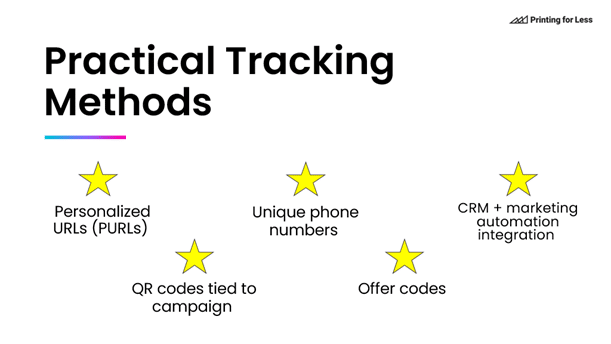
Unique coupon codes are among the most effective tools.  

“A simple suffix convention—”PC” for postcard, “E” for email—makes attribution simple,” Explained Sikkink. QR codes can link to unique landing pages, feed directly into Google Analytics, or trigger automated follow-up sequences in marketing platforms such as Salesforce, Marketo, or Eloqua. 

She also recommended pairing QR codes with the associated web address printed nearby—giving tech-hesitant recipients the option to type the URL instead. Other practical tracking mechanisms include personalized URLs (PURLs), unique phone numbers per channel, and physical card turn-ins. 

“Just make sure you’re capturing the data,” Amber urged. 

The Multi-Touch Mindset 

One of the session’s most actionable takeaways was the argument against single-send campaigns. Sikkink drew on basic consumer psychology: one mailer creates mild interest; a second reinforces it and drives action. 

“Put yourself in the recipient’s standpoint,” she said. “If you get one offer, you’re kind of like, ‘Oh, maybe.’ But if you get a second, it starts to push you over the edge.” 

Takeaway for Direct Mail Marketers 

For businesses wondering whether direct mail still earns its place in a digital-first marketing mix, the answer from Printing for Less’s practitioners is unambiguous: When the creative is right, the targeting is precise, and the offer is compelling, the mailbox remains one of the most powerful channels available. 


From Bad to Best: Fixing Direct Mail That Doesn’t Perform

Not all direct mail is created equal—and small mistakes can have a big impact on results. In this session from Printing for Less, we’ll take a practical, before-and-after approach to improving underperforming direct mail campaigns.   

Using real examples, we’ll identify what causes direct mail to fall flat and demonstrate how thoughtful improvements in design, messaging, format, and tracking can significantly improve performance. The session will focus on two proven formats: postcards and letters mailed in double window envelopes. Attendees will see side-by-side comparisons of ineffective versus optimized mail and walk away with actionable ideas to apply immediately.  

Key Takeaways 

How to add simple, effective tracking to measure performance and results 

The most common reasons direct mail fails and how to fix them.   

How design, layout, and messaging impact response for postcards and letter packages.   

When to use a postcard and when to use a letter in a double window envelope.   

Why Direct Mail Deserves a Place in the Modern Marketer’s Toolkit

Why Direct Mail Deserves a Place the Modern Marketer’s Toolkit

By The Printing for Less Team

For a Printing for Less roundtable, three seasoned marketing professionals gathered to unpack how direct mail — thoughtfully executed and well-integrated — can pierce the “digital clutter,” build meaningful connections, and drive measurable business outcomes.  

Led by Jennifer Bellin, Chief Marketing Officer at Printing for Less and a veteran direct mail practitioner, the conversation brought together diverse perspectives: Gretchen Swann, Senior Principal Marketing Program Manager at Paycor; Rob Willingham, Director of Marketing at LexisNexis; and Paul Bobnak, Direct Mail Evangelist at “Who’s Mailing What.” Together, they shared how they got started with mail, what motivates their strategies today, and why direct mail deserves a place in every modern marketer’s toolkit.  

From Manual to Strategic: How It All Started

For many marketers, the route into direct mail wasn’t planned — but it became purposeful.

Gretchen Swann recalls Paycor’s early experiments with direct mail. “We were basically mailing things out ourselves from our office,” she said, describing a time of hand-assembling packages, wrestling with spreadsheets, and dealing with returned mail due to bad addresses. The results were promising but the process wasn’t scalable—yet.

Rob Willingham’s entry was equally organic. “I don’t have a direct mail background,” he admited. When he inherited the channel at LexisNexis, direct mail was little more than ad-hoc gift cards and small gestures from sales reps. Identifying an opportunity, Rob piloted a structured approach that became the foundation of a broader, more strategic program. “Direct mail soon became a new channel of pipeline that’s continued to expand,” he explained.

For Paul Bobnak, the journey came through deep immersion. Taking the reins at “Who’s Mailing What”—a repository and analysis hub of thousands of pieces of mail each year — Paul learned “all the rules you’re supposed to follow and the rules that you can break.” His perspective, forged by constant exposure to mail campaigns across industries, brings seasoned context to how teams think about mail today.

Why Direct Mail Still Matters

As the dialogue shifted toward objectives and priorities, a theme emerged: direct mail isn’t just a novelty; it’s a strategic asset that drives pipeline, engagement, and revenue.

Willingham made it clear: “My priority is to make money and drive pipeline,” he explained. In a digital age where prospects are inundated with emails, he sees direct mail as an experiential channel that can surprise and delight—something that stands out compared with routine digital touchpoints.

Swann echoed this perspective from the B2B world. “We get so many emails people are quick to delete them all,” she said. For Paycor, direct mail is a way to break through, grab attention, and spark curiosity that leads to real conversations with sales teams.

However, the value of mail goes beyond novelty. As Swann put it: “It’s almost unusual when you get an actual physical piece of direct mail.” That rarity translates into engagement—a moment of connection that digital alone struggles to achieve.

Strategic vs. Tactics

The panel was quick to point out that direct mail isn’t an isolated tactic—it is part of a cohesive strategy. For marketers craving better results, thinking holistically matters.

“Direct mail really is breaking through more than other channels right now,” said Swann, pointing to the discipline’s ability to augment and uplift other campaigns. For B2B teams, that often means weaving mail into broader nurtures and journeys that span digital and physical touchpoints.

Willingham’s pilot ultimately wasn’t just about sending mail—it was about establishing processes, measuring impact, and earning organizational trust. His early success enabled the channel to scale, proving that, with the right strategy, direct mail can mature into a consistent growth driver.

The Mailbox Advantage

What becomes clear from the roundtable discussion is that direct mail’s value isn’t a throwback to “old-school” marketing—it’s about crafting memorable moments that connect with people in ways digital rarely can

Whether hand-assembling packages in an office or piloting a new ABM channel, these leaders found that intentional mail, used strategically, doesn’t just reach audiences—it resonates with them.

The Universal “Buyer’s Guide” Framework

The Universal "Buyer’s Guide" Framework

By The Printing for Less Team

This playbook combines an evergreen, industry-agnostic foundation with modular industry-specific pages that allow marketers to tailor messaging without reinventing strategy or structure.

Part I: The Universal Buyer’s Guide Framework

1. Why Direct Mail Buyer’s Guides Work

Buyer’s Guides are one of the most effective direct mail solutions when audiences are faced with complex choices, unfamiliar terminology, or high-stakes decisions. Unlike promotional mail, Buyer’s Guides are designed to educate first and convert later.

Curiously, physical formats slow the decision process in a productive way. They create space and time for clarity, comprehension, and trust—three factors that digital-only experiences often struggle to deliver. Well-designed Buyer’s Guides consistently outperform short-form mail when the goal is confidence-building rather than impulse.

Why Direct Mail Buyer's Guides Work

2. When to Use a Buyer’s Guide

Buyer’s Guides are most effective when decisions are not obvious or immediate. They perform best in those moments when customers need help understanding options, comparing solutions, or navigating next steps.

Common triggers include:
• Multiple products, plans, or services
• Regulated or compliance-heavy environments
• Long or multi-stakeholder buying cycles
• Onboarding, enrollment, or renewal moments
• Product expansion or re-engagement opportunities

Across the customer lifecycle, Buyer’s Guides can support early education, mid-funnel consideration, onboarding, and long-term relationship building.

3. Choosing the Right Format

Selecting the right format is critical to the success of a Buyer’s Guide. The format should reflect the complexity of the decision, the depth of content required, and the value of the offer.

Choosing the Right Format

‍
Common formats include:
• 8 – 12 page booklets for focused education.
• 12 – 24 page catalogs for broader solution storytelling.
• Trifold or gatefold self-mailers for concise guidance.
• Envelope-based kits for high-touch experiences.

When choosing a format, consider audience size, personalization needs, budget, timeline, and postage efficiency. Larger formats often outperform smaller ones when education is the primary goal, while self-mailers can be effective when speed and visibility matter most.

4. The Buyer’s Guide Content Framework

A successful Buyer’s Guide follows a clear, repeatable structure that guides readers from context to confidence.

Recommended flow:
1. Welcome and Context—Why the guide exists.
2. The Audience Challenge—Framed in customer language.
3. Solution Overview—Clear, plain-English explanations.
4. Options and Comparisons—Visual tables and summaries.
5. What to Look for—Decision-criteria checklist.
6. Proof and Validation—Case study, testimonial, or data point.
7. Next Steps—Clear call to action (CTA) supported by QR or digital bridge.

The design should make it easy to scan, while prioritizing white space and visual hierarchy to encourage engagement.

5. Personalization and Connected Experiences

Personalization enhances relevance and helps Buyer’s Guides feel intentional rather than generic. Even light personalization—such as tailored introductions or segment-based CTAs—can significantly increase engagement.

Connected experiences extend the value of the printed guide. QR codes, personalized URLs, and AI-assisted summaries allow recipients to continue their journey digitally, access demos, compare options, or schedule next steps.

6. Multi-Touch Extensions

Buyer’s Guides are most powerful when used as part of a multi-touch journey. They can anchor a sequence that reinforces messaging and guides recipients toward action.

Multi-Touch Extensions

‍
Common extensions include:
• Buyer’s Guide followed by a reminder postcard.
• Buyer’s Guide followed by a personalized letter.
• Buyer’s Guide triggering a digital nurture or sales outreach.

These journeys can support acquisition, onboarding, re-engagement, or expansion efforts.

7. Measurement and Optimization

Measurement ensures that Buyer’s Guides remain accountable and continuously improve.

Key metrics include:
• QR scans by section or CTA
• Landing page engagement
• Conversion actions, such as scheduling or enrollment
• Performance by segment or industry

Optimization opportunities include testing page count, CTA placement, format type, and timing between touches.

8. Production Planning

Successful Buyer’s Guides require thoughtful production planning. Teams should align early on creative timelines, data readiness, finishing requirements, and mail-drop schedules.

Clear planning reduces delays, manages expectations, and ensures a seamless experience from concept to mailbox.

9. Templates and Tools

To make execution easier, Buyer’s Guides should be supported by practical tools, including:

• A fillable content outline
• Format selection worksheets
• CTA planning guides
• AI prompt libraries
• Multi-touch journey planners

‍

In a marketing landscape increasingly defined by speed and noise, Buyer’s Guides stand out by doing the opposite: creating space for informed choice, meaningful engagement, and long-term relationship building—one mailbox at a time.

‍

Part II: Industry-Specific Applications

The following pages layer industry relevance onto the universal Buyer’s Guide framework. Each page highlights common challenges, recommended formats, and messaging guidance to help teams tailor execution without changing strategy.

Specific Applications

Financial Services

Financial decisions require trust, clarity, and confidence. Buyer’s Guides help simplify complex products while reinforcing credibility. ‍

Use cases include:
• Commercial banking solution guides
• Wealth management overviews
• Lending portfolios
• Client onboarding materials.

Financial Services

Recommended formats include 12 – 24 page booklets or catalogs with structured comparisons.
CTAs often focus on consultations, solution exploration, or relationship reviews.

Download an example of a Buyer’s Guide for Financial Services.

Healthcare

Healthcare audiences face complex, regulated decisions that benefit from clear, well-organized education. ‍

Buyer’s Guides are effective for:
• Benefits selection
• Provider navigation
• Member onboarding  
• Enrollment support

Healthcare

Formats should prioritize readability and reassurance, often using booklets or directories.
CTAs may include plan comparisons, care access tools, or enrollment actions.

Download an example of a Buyer’s Guide for Healthcare.

Technology (B2B/SaaS)

Technology purchases often involve multiple stakeholders and technical complexity. ‍

Buyer’s Guides help:
• Translate features into outcomes
• Support product launches
• ABM efforts
• Adoption campaigns

Recommended formats include concise booklets paired with digital demos.
CTAs typically drive demo requests, feature exploration, or strategy conversations.

Download an example of a Buyer’s Guide for Technology companies.

Retail and Consumer Brands

Retail Buyer’s Guides emphasize storytelling, curation, and inspiration. ‍

Retail

‍They work well for:
• Seasonal lookbooks
• Curated collections
• Loyalty programs
• Early-access campaigns

Visual formats such as catalogs and self-mailers perform strongly.
CTAs often focus on shopping, unlocking access, or discovering collections.

Download an example of a Buyer’s Guide for Retail.

Conclusion ‍

Buyer’s Guides work because they respect and enhance the way real decisions are made. They slow the process just enough to replace confusion with clarity and promotion with confidence. When thoughtfully designed, personalized, and connected to the broader customer journey, they become more than a piece of mail—they become a trusted reference that earns attention, builds understanding, and creates action. In a marketing landscape increasingly defined by speed and noise, Buyer’s Guides stand out by doing the opposite: creating space for informed choice, meaningful engagement, and long-term relationship building—one mailbox at a time.

  • Page 1
  • Page 2
  • Page 3
  • Interim pages omitted …
  • Page 48
  • Go to Next Page »

Footer

Printing for Less

info@printingforless.com
100 P F L Way, Livingston, MT 59047

800-930-2423

  • Home
  • Products
  • Services
  • Industries
  • Get Printing Samples
  • Direct Mail Marketing Resource Center
  • Printing Resource Center
  • Blogs
  • Templates
  • Terms & Conditions
  • Contact
  • About Printing for Less
  • Careers
  • Login

Copyright © 1998-2026 PrintingforLess.com. All Rights Reserved.

logo
  • 800-930-2423
  • Products
  • Direct Mail Marketing
  • Services
  • Industries
  • Direct Mail Marketing Resources
  • Printing & Mailing Resources
  • Get a Quote
  • Contact Us
  • My Login
Direct Mail Delivery
This field is for validation purposes and should be left unchanged.

Get 20% Off*

Your First Print Order

Name(Required)

*By subscribing, you agree to receive weekly emails from Printing for Less. Some exclusions apply. See details.